

Last week, I emailed my subscribers and asked them to choose one word that best described the chapter of life they were in.
The choices were:
- Living
- Changing
- Dreaming
- Giving
- Enduring
One reader chose a different word:
Preparing.
The reader explained that household financial decisions currently center on preparing for the next chapter.
In essence, the reader asked:
When can Preparing become Realizing, Enjoying, or Benefiting?
That question stayed with me.
Many thoughtful, responsible people spend decades preparing for retirement. They work, save, invest, care for others, manage risk, and postpone some things because other responsibilities come first.
They become very good at preparing.
But eventually, they face a different question:
How will I know when I have prepared enough to begin living differently?
That tension helps explain why Even More Than Money: Five Ways to Design Your Financial Life feels so relevant. The book explores five ways money can support a life: Living, Changing, Dreaming, Giving, and Enduring. It invites readers to see money not only as something to accumulate or protect, but as a tool for supporting the life they want to live.
If you have been thinking about when preparation should begin giving way to living, I have a limited number of complimentary copies of Even More Than Money available.
[Request a complimentary copy]
When Preparing for Retirement Becomes the Default
Preparation matters.
It can create security, reduce uncertainty, and make retirement, generosity, travel, a career change, or another goal financially possible.
But preparation can also become a habit.
You reach one savings target and set another. You tell yourself that one more year of work will make you feel more confident. You wait for the market to settle down, health care costs to become clearer, or the future to feel easier to predict.
You keep preparing because preparing feels responsible.
Using what you have built can feel much less comfortable.
For decades, your financial life may have followed a familiar pattern:
- Earn
- Save
- Invest
- Repeat
Retirement changes that pattern. Instead of adding to your accounts, you may begin withdrawing from them. Instead of receiving a paycheck from an employer, you may need to create your own retirement paycheck from Social Security, pensions, retirement accounts, taxable investments, and other resources.
The financial analysis may support the transition, and it can still feel wrong.
But sometimes the numbers do not yet support it.
Another year of work might meaningfully improve your financial flexibility, strengthen your reserves, reduce debt, or address an important risk. The point is not to persuade everyone to retire sooner or spend more.
The point is to understand what continued preparation is accomplishing.
Ask yourself:
What would one more year of work actually buy me?
Would it materially improve the plan?
Would it create an option that matters to me?
Or would it provide temporary reassurance before I set another target?
How Do You Know What You Need Next?
There is no universal finish line. But three questions can help you determine whether continued preparation is useful or has become a form of delay.
What Does the Financial Analysis Support?
Running out of money is a real concern.
A thoughtful financial plan should account for spending, taxes, health care, inflation, investment risk, liquidity, longevity, family needs, and other uncertainties. It should also help you understand the relevant assumptions and how the plan might respond if circumstances change.
No plan can eliminate uncertainty.
The goal is not perfect certainty. It is informed confidence based on the analysis you understand, the trade-offs you have considered, and a plan you can adjust when life changes.
Even then, the shift from saver to spender can be difficult.
For much of your life, saving may have represented progress. Each contribution strengthened your sense of security. Withdrawing money can feel like taking a step backward, even when the plan supports the spending.
You may look at a trip, home improvement, family gift, or decision to hire help and ask:
Do I really need this?
What if I need the money later?
Should I wait another year?
Those are reasonable questions. But if you ask them automatically every time, your retirement plan may protect your money more effectively than it supports your life.
Money accumulated for retirement should eventually support the retirement you value. That may include spending, maintaining financial reserves, helping people you care about, preserving flexibility, or leaving a legacy.
A financial planner can help evaluate what the numbers support and explain the trade-offs. But the decision should ultimately reflect your priorities, not simply an advisor’s permission.
What Are You Moving Toward?
Preparing for retirement is not only a financial transition. Work often provides more than income. It may provide structure, relationships, identity, recognition, purpose, and a reason to get up each morning.
Caregiving can do the same. After years of caring for children, parents, a spouse, or other family members, the end of that role can leave unexpected space.
So the question may not be only:
Can I afford to retire?
It may also be:
Who will I be when I am no longer doing what has defined me for so long?
Many people know what they want less of: stress, commuting, time demands, and work that no longer fits.
They may still be exploring what they want more of.
That does not mean retirement will disappoint them. It means the next chapter may require experimentation rather than one perfect answer.
At Apprise, I think about this through the lens of your TEAM of Capital:
- Time
- Energy
- Attention
- Money
If you focus only on protecting your money while time passes, energy changes, or fear consumes your attention, you may preserve one resource at the expense of the others.
The question cannot be only:
How much more should I save?
It should also include:
How do I want to use my time?
What deserves my energy and attention?
What do I want my money to make possible?
Preparation creates security.
Security can create freedom.
But freedom still needs direction.
What Can You Begin Practicing Now?
Preparing and living do not have to be opposites. They can overlap.
You can try a reduced schedule before leaving work completely.
You can take a meaningful trip without waiting for retirement.
You can volunteer, mentor, create, or reconnect with people before your final workday.
You can hire help now to protect your time and energy.
You can act on your charitable intentions during your lifetime rather than postponing them.
You might practice living on your anticipated retirement cash flow or begin making intentional withdrawals for experiences you have carefully planned.
The right experiments depend on your circumstances. Their purpose is not to force a transition. It is to learn what the transition might feel like while you still have room to adjust.
The question does not have to be:
When do I stop preparing entirely?
A better question may be:
What part of the life I have been preparing for can I begin now?
Five Ways to Think About What Comes Next
This is one reason I wanted to contribute to Even More Than Money.
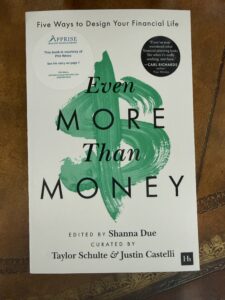
The book does not offer one formula for a meaningful financial life. Instead, its introduction describes five purposes money can serve:
Living
Knowing when to spend generously and when to save wisely, balancing security and joy.
Changing
Using money to support successful transitions while avoiding the emotional traps that can turn it into an obstacle.
Dreaming
After meeting your basic needs, using money to pursue meaningful goals and deeper aspirations.
Giving
Experiencing the benefits of generosity while avoiding the complications of giving with strings attached.
Enduring
Building financial security that lasts and creating a legacy that reflects your deepest values.
Together, these five purposes shift the focus from whether you have accumulated enough to whether you are using what you have in ways that matter.
My chapter opens the book in the “Living” section and centers on a question that reaches beyond one person’s story:
What kind of life do I want to live?
The book cannot answer that question for you, but it may help you ask it more clearly.
A Question to Sit With
What word best describes your relationship with money right now?
Preparing?
Protecting?
Waiting?
Living?
Changing?
Dreaming?
Giving?
Enduring?
Then ask yourself:
What would need to be true for that word to change?
Do the numbers or the plan need to change? Do you need more preparation? Or do you need greater clarity about what you want the next chapter to make possible?
Preparation matters.
But preparation is not the destination.
At some point, the purpose of preparing is to begin.
Request a Complimentary Copy
If you are preparing for retirement but are unsure how to begin living the next chapter, Even More Than Money may offer useful questions to consider.
I have a limited number of complimentary copies available for readers who may find this message especially relevant.
[Request a complimentary copy]
I will personally review each request and follow up with next steps.
Related Reading:
- You May Have Enough Money. But Do You Have Enough Life?
- Creating a Retirement Paycheck
- What is Money For? A Deeper Question Behind Your Financial Plan
This content is for informational and educational purposes only and should not be considered financial, legal, or tax advice. Your circumstances are unique, and you should consult the appropriate professional before making decisions based on your personal situation.
Our practice continues to grow through introductions from our clients and friends. Thank you for your trust.
If you would like to discuss financial topics, including navigating new beginnings, managing your investments, creating a life plan, or saving for retirement, please schedule a call or a Zoom virtual meeting. We will be in touch.
Follow us:
Facebook | LinkedIn | Instagram | YouTube | Substack
Please note: We post information about articles that can help you make better money-related decisions on Facebook, LinkedIn, Instagram, and YouTube. You can subscribe to have articles delivered to you via Substack.

For firm disclosures, see here: https://apprisewealth.com/disclosures/

Phil Weiss founded Apprise Wealth Management, where he works with women facing new beginnings. He started his financial services career in 1987 working as a tax professional for Deloitte & Touche. For the past 25 years, he has worked extensively in the areas of personal finance and investment management. Phil is a CFA charterholder, a CPA, and an RLP®.