

When it comes to your money, can you answer the question, “What is Money for?”
Most people can explain what they want their money to do financially.
- They want it to provide income.
- They want it to support retirement.
- They want it to help reduce risk.
- They want it to support their family.
- They want it to create security.
- They want it to last.
Those goals matter.
A good financial plan should help you understand whether your money can do those things. It should help you evaluate income, expenses, investments, taxes, estate planning, insurance, risks, and tradeoffs.
But another question often gets less attention.
What is money for?
Not just financially.
Personally.
- What can your money help make possible?
- What do you want it to protect?
- What do you want it to support?
- What can it help you change, create, give, or withstand?
That is a different kind of question.
It does not replace the numbers. The numbers still matter. But it gives the numbers a clearer purpose.
Key Points
|
Money Is Not Only for Security
Security matters.
It is hard to make thoughtful decisions when you do not feel financially safe. It is hard to think clearly about the future when you are worried about income, health care, housing, debt, market volatility, taxes, or whether you might run out of money.
During the life planning process, I often ask a simple question:
What is most important about money, to you?
The two answers I hear most often are security and freedom.
That makes sense. For many people, money first represents safety. It helps protect against uncertainty. It helps provide stability. It helps reduce the fear of running out, becoming dependent, or losing control. It can also help you take care of your basic needs.
But as financial security grows, the answer to “what is money for?” can begin to change.
Money may still represent security. But it can also begin to represent freedom.
- Freedom to make a change.
- Freedom to spend time differently.
- Freedom to help someone else.
- Freedom to leave work that no longer fits.
- Freedom to say yes to something meaningful.
- Freedom to travel while you have the health, time, and energy to enjoy it.
- Freedom to stop organizing every decision around fear.
That shift matters.
But freedom still needs direction.
The deeper question is not only whether your money gives you freedom. It is what that freedom is for. In other words, what is your money for once security is no longer the only concern?
That is why the practical side of financial planning still matters.
- Can I retire?
- Can I stop working full-time?
- Can I afford to help my children?
- Can I support myself after a divorce?
- Can I manage financially after losing a spouse?
- Can I pay for care if I need it?
- Can I give money away without jeopardizing my own future?
Those are important questions.
But providing security is not money’s only purpose.
If the goal is only to protect against every possible risk, you may never feel free to use what you have built.
You may keep saving even after additional savings no longer meaningfully change your choices.
You may keep working because work feels safer than change.
You may avoid spending on things that would make your life better because spending feels irresponsible.
You may postpone meaningful experiences because the future always seems to need more protection.
That does not mean caution is wrong.
It means caution needs context.
Money can help protect your future. But it can also support your present.
A good financial plan should help you understand both.
From Security to Freedom, Then Purpose

That is where “what is money for?” becomes more than a financial question.
If money gives you more freedom, what is that freedom for?
- Freedom is not the destination by itself. It needs direction.
- Freedom to live more fully.
- Freedom to navigate change with more confidence.
- Freedom to pursue a dream you have postponed.
- Freedom to take a meaningful trip while the opportunity is still available.
- Freedom to give in a way that reflects your values.
- Freedom to endure a difficult chapter with more stability and support.
That is one reason the five themes in Even More Than Money resonate with me:
- Living
- Changing
- Dreaming
- Giving
- Enduring
They help move the conversation from “Do I have enough?” to “What is my money for and what do I want it to make possible?”
The Question Behind the Question
When someone asks, “Do I have enough?” the question underneath may be different.
Sometimes the real question is:
Can I stop doing work that is wearing me down?
Sometimes it is:
Will I be okay if I am on my own?
Sometimes it is:
Can I afford to spend money on myself after years of taking care of everyone else?
Sometimes it is:
Can I make a change without disappointing people who depend on me?
Sometimes it is:
Have I earned the right to enjoy what I have built?
Those questions deserve more than a quick answer.
They deserve planning, reflection, numbers, and honesty.
If you do not know how to answer, “What is money for?” then “more” can become the default answer.
- More savings.
- More work.
- More caution.
- More delay.
- More waiting.
At some point, the better question may not be, “How do I get more?”
It may be:
What do I want this money to make possible now?
Five Ways Money Can Support a Life
On July 21, Even More Than Money: Five Ways to Design Your Financial Life, a book I contributed to, will be released.
The book explores five themes that shape how people design their financial lives:
- Living
- Changing
- Dreaming
- Giving
- Enduring
Those words are simple. But they point to something important.
Money does not have only one purpose. Its purpose can change depending on where you are in life and what you are facing.
For one person, money may be about learning how to live more fully after years of being responsible.
For another, it may be about navigating a major life change.
For someone else, it may be about giving more intentionally, pursuing a dream, or enduring a difficult chapter with more stability and support.
That is why the question “What is your money for?” matters.
The answer may not be the same for everyone.
It may not even be the same for you at every stage of life.
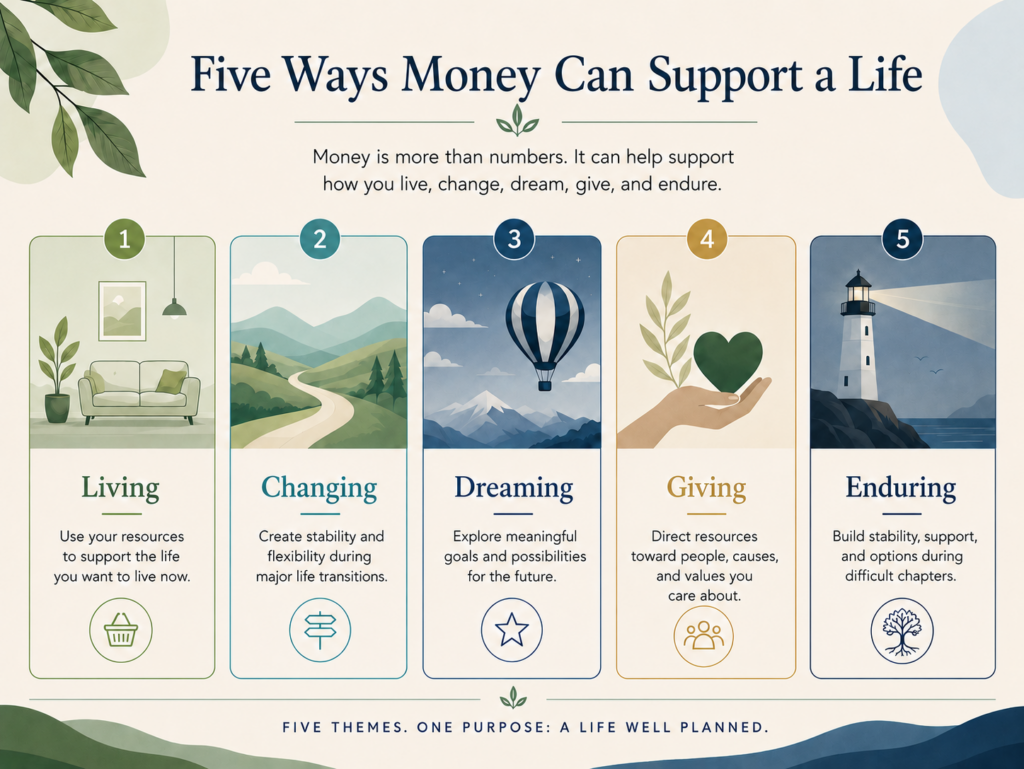
Each theme offers a different way to answer the question, “What is money for?” The point is not to fit your life neatly into one category. The point is to notice which purpose feels most relevant now.
Money for Living
Money for living is not about spending carelessly. It is about asking whether your financial resources support the life you want to live.
That might mean retiring earlier than you once expected, working part-time instead of full-time, traveling while you have the health and energy to enjoy it, hiring help so you can spend less time and energy on tasks that drain you, or saying yes to something meaningful while the opportunity is still available.
The question is not only:
Can I afford this?
It is also:
Would this help me live in a way that reflects what matters most to me now?
Money for Changing
Major life transitions can change what money is needed for.
Retirement changes how you think about income and cash flow. Divorce can change your household, finances, identity, and confidence. Widowhood can bring grief, paperwork, and a new level of responsibility. An empty nest can create space, but also uncertainty. A career change can raise questions about security, purpose, and what comes next.
During a transition, your money may need to provide stability, create breathing room, and help you avoid rushed decisions.
The financial questions matter. What income do I need? What risks do I need to manage? How much should I keep liquid? What decisions should I avoid making too quickly? What tax issues should I understand before taking action?
But the life questions matter, too. Who am I becoming now? What no longer fits? What do I need to protect? What do I need to rebuild?
Money for Dreaming
Dreaming can feel uncomfortable for responsible people.
If you have spent years taking care of others, saving diligently, and preparing for the future, dreaming may feel indulgent. But dreams do not have to be extravagant.
A dream may be spending more time with grandchildren, writing, teaching, mentoring, traveling, volunteering, moving closer to family or friends, or creating more space for rest.
It may be doing something you postponed because life had other demands.
The financial question is not whether every dream deserves funding. Some dreams may not fit your life, your resources, or your values.
The question is whether you have allowed yourself to evaluate the dream honestly.
What would it cost? What would it require? What would you need to change? What would you regret if you never explored it?
Money for Giving
Giving can be one of the clearest ways money reflects values.
It can support family, causes you care about, someone at a meaningful moment, or work you want to see continue. It may allow you to experience some of the impact of your generosity during your lifetime.
This one is personal for me.
I am working to fund a scholarship for women who return to school later in life, as my mother did. That goal has become part of my own life plan.
That does not mean everyone needs a scholarship, a foundation, or a formal giving strategy. But it does mean giving deserves a place in the conversation.
If money is a tool, generosity is one way to use it.
Money for Enduring
Not every chapter of life is about expansion.
Some chapters are about enduring: a health diagnosis, the death of a spouse, divorce, family conflict, caregiving, job loss, or another difficult transition that changes more than you expected.
In those moments, money may not create joy. But it can help create stability, support, and options.
It can help you avoid rushed decisions, pay for care, simplify, delegate, take time before making major choices, or move through an overwhelming period.
Sometimes the purpose of money is not to help you chase a dream.
Sometimes its purpose is to help you stand on steadier ground while you face something hard.
That, too, is part of a well-designed financial life.
Your TEAM of Capital
At Apprise, I often think about planning through the lens of your TEAM of Capital:

- Time.
- Energy.
- Attention.
- Money.
Money matters. But it is only one part of the equation.
You can have enough money and still be short on time.
You can have enough income and still feel drained.
You can have enough saved and still give your attention to things that no longer fit.
You can have enough financial security and still feel unsure what life is supposed to look like now.
That is why asking “what is money for?” should not be limited to dollars.
It should include your time.
Where is your time going? Does that reflect what matters most now?
It should include your energy.
What gives you energy? What drains it? What could your money help you protect or restore?
It should include your attention.
What keeps occupying your mind? What financial clutter, uncertainty, or unfinished decision keeps taking up space? What are you giving your attention to that pulls you away from the things that matter most to you?
And yes, it should include your money.
Are you using your money in a way that supports your values, needs, goals, and peace of mind?
When these resources are aligned, planning becomes more than a set of projections.
It becomes a way to support the life you want to live.
Which Word Fits Where You Are Now?
- Living.
- Changing.
- Dreaming.
- Giving.
- Enduring.
Which one feels most relevant to you right now?
If you are approaching retirement, maybe the word is “Living.”
You may be asking what you want life to look like when work no longer defines the week.
If you are going through a divorce, maybe the word is “Changing.”
You may be rebuilding not only your finances, but your confidence and identity.
If you are widowed, maybe the word is “Enduring.”
You may be carrying grief while also facing decisions you did not expect to make alone.
If you have spent years taking care of everyone else, or if you are approaching an empty nest, maybe the word is “Dreaming.”
You may be wondering whether it is finally time to name something for yourself.
If you are thinking about legacy, family, or impact, maybe the word is “Giving.”
You may be asking how your resources can support what matters beyond you.
There is no single right answer.
But there is value in naming the question.
Why I Contributed to This Book
My chapter opens the book and appears in the “Living” section of Even More Than Money.
It tells the story of someone who had financial security but still needed to answer a deeper question:
What kind of life do I want to live?
That question is not limited to one person or one story.
I see versions of it often.
A person can have a strong balance sheet and still feel uncertain about what comes next. A person can have enough money on paper and still not have enough life in practice. A person can be financially secure and still struggle to give herself permission to use that security.
That is why this project matters to me.
Not because money is unimportant.
It is important.
But money is most useful when it supports something larger than itself.
A Question to Sit With
Before you ask only whether you have enough, ask:
What is my money for in this chapter of my life?
One simple place to start is to choose the word that feels most relevant now:
- Living.
- Changing.
- Dreaming.
- Giving.
- Enduring.
Then ask:
- Why that word?
- Why now?
- What would need to change for my money to support that part of my life more fully?
You might also ask:
- What do I want it to make possible?
- What would I like it to protect?
- What can it do to help me change?
- What dream have I postponed?
- What do I want to give that may allow me to see the impact?
- What hard thing do I need support to endure?
- Where are my Time, Energy, Attention, and Money out of alignment?
These questions may not produce immediate answers.
That is okay.
They are not meant to replace the financial analysis.
They are meant to give the financial analysis a clearer target.
The answer still has to work financially.
A meaningful goal does not remove the need to evaluate cash flow, taxes, investment risk, liquidity, insurance, estate planning, and long-term care needs. It gives that analysis a clearer purpose.
The planning work is where the question becomes practical:
- Can this decision work?
- What would need to change?
- What tradeoffs would it create?
- What risks would need to be managed?
If this question feels relevant to you, I have a limited number of complimentary copies of Even More Than Money available for people who may find this message especially useful.
You can request a copy here: [Request a copy]
If the request form is not available when this post is first published, I will update this page once it is ready.
Related Reading
- You May Have Enough Money. But Do You Have Enough Life?
- Financial Planning After a Major Life Change: Before You Ask, “Do I Have Enough?” Ask This Instead
- Life Planning Training: Reinforcing My Purpose
- Carl Richards Interview: Four Sources of Capital
Frequently Asked Questions
What is Even More Than Money about?
Even More Than Money: Five Ways to Design Your Financial Life explores how money can support a meaningful life through five themes: Living, Changing, Dreaming, Giving, and Enduring.
Why should I ask what my money is really for?
Because money is a tool, and the way you answer “what is money for?” can shape planning decisions that follow. A financial plan can help you evaluate what may be possible, but the deeper question is what you want your money to support, protect, change, create, give, or help you endure.
How does this relate to retirement planning?
Retirement planning is not only about deciding when, or whether, you can stop working. It is also about deciding what retirement can make possible and how your Time, Energy, Attention, and Money can support the life you want to live.
This content is for informational and educational purposes only and should not be considered financial, legal, or tax advice. Your circumstances are unique, and you should consult the appropriate professional before making decisions based on your personal situation.
Our practice continues to grow through introductions from our clients and friends. Thank you for your trust.
If you would like to discuss financial topics, including navigating new beginnings, managing your investments, creating a life plan, or saving for retirement, please schedule a call or a Zoom virtual meeting. We will be in touch.
Follow us:
Facebook | LinkedIn | Instagram | YouTube | Substack
Please note: We post information about articles that can help you make better money-related decisions on Facebook, LinkedIn, Instagram, and YouTube. You can subscribe to have articles delivered to you via Substack.

For firm disclosures, see here: https://apprisewealth.com/disclosures/

Phil Weiss founded Apprise Wealth Management to help women facing new beginnings understand their financial lives, make thoughtful decisions, and use their money in ways that support what matters most to them.