This year’s Berkshire Hathaway annual shareholders’ meeting felt different before I even arrived in Omaha.
For decades, the meeting centered around Warren Buffett and Charlie Munger. Investors came for business insight, but many also came for wisdom about judgment, reputation, patience, and how to live.
This year marked a new chapter. Charlie Munger passed away in 2023. Warren Buffett has stepped away as CEO, though he remains Chairman. Greg Abel led the meeting for the first time as Berkshire’s CEO. The result was a meeting focused less on Buffett’s personal wisdom and more on Berkshire’s businesses, culture, and future.
I was not sure how that change would feel. In the end, I’m glad I made the trip.
I have attended the meeting in most years since 2014. You can also read some of my prior Berkshire write-ups from 2022, 2024, and 2025, as well as listen to my 2022 podcast appearance.
Warren Buffett and Charlie Munger have topped my list of favorite investors since before I bought my first shares, which I still own. (Berkshire first issued its “B” shares in May 1996.) I first purchased Berkshire shares in 1998 and have added to my position over time. I also include Berkshire shares in client portfolios that include individual stocks. (Please see disclosure at the end.)
A Different Format
In prior years, questions directed at Buffett and Munger often went far beyond investing. Many overlapped with life planning-related concepts: judgment, patience, reputation, relationships, work, money, and purpose.
That broader wisdom attracted many people to Omaha. Some traveled long distances not only to hear about Berkshire, but also to hear Buffett and Munger reflect on life. I met several first-time attendees this year, but the number seemed lower than in prior years.
As a life planner, I have always appreciated the personal side of the meeting. As a shareholder and investor, I also value the insight into Berkshire’s businesses.
New Meeting Focus
With Greg Abel leading the meeting, the focus shifted noticeably. The discussion centered more directly on Berkshire’s businesses, operating discipline, capital allocation, and long-term structure.
Greg reviewed Berkshire’s first-quarter earnings. Ajit Jain joined Greg to discuss the insurance business. Katie Farmer of BNSF Railway and Adam Johnson, who oversees NetJets, Brooks Running Shoes, and other consumer-related divisions, joined Greg later in the day for additional Q&A.
The result was a meeting that provided more detailed information about Berkshire’s operations than prior meetings did. That likely benefited shareholders and investors who wanted a deeper look inside Berkshire’s businesses. Those who primarily came to hear Buffett and Munger’s broader wisdom may have left disappointed.
For me, the change was useful. It highlighted an important point: transitions reveal culture. When the familiar voices are no longer leading the conversation, values, discipline, and stewardship matter even more.
Before sharing my closing thoughts, I will highlight the 10 ideas that stood out most from the weekend. They are not only investment lessons. They are also planning lessons involving patience, stewardship, reputation, knowing when to say no, and using capital wisely.
The Weekend
One of the primary reasons I continue attending the Berkshire meeting did not change this year. While there were fewer events, I found many to attend. Plus, I got a chance to catch up with friends that I talk to on occasion throughout the year, but only see in person when I attend the Berkshire meeting.
In many ways, long-term Berkshire shareholders reflect the company’s culture. I cannot recall meeting anyone at the weekend’s events whom I did not like or respect. I have met many thoughtful, generous people there.
Berkshire shareholders tend to think like long-term owners. That perspective differs from the mindset of those focused primarily on short-term price movements. A shorter-term focus often looks more like speculation than investing.
Long-term investors worry less about daily stock price movement and more about whether a business is becoming stronger over time. They also tend to be calmer. They listen more. They are less likely to attack those who think differently.
For me, a personal highlight came on Saturday night at a group dinner hosted by my friend Chris. About 20 of us attended. The evening included good food, thoughtful conversation, and the kind of connection that keeps bringing me back to Omaha.
Highlights
As in the past, I will focus on the highlights that align most closely with life planning, not just investing. I will also include a few lessons from events beyond the shareholders’ meeting. The items appear chronologically.
1. Knowledge sharing is a responsibility.
At VALUEx BRK 2026, hosted by Guy Spier, Steven Jones, who succeeded Charlie Munger as Chairman and CEO of the Daily Journal Corporation, shared two memorable quotes from Charlie Munger. One was particularly blunt:
-
- The best thing another person can do is help another person know more.
- You don’t have a fiduciary responsibility to be a total shit as you go through life.
Munger believed sharing knowledge was not merely a polite gesture. It represented a moral imperative and the highest form of human utility. He believed he was a beneficiary of the great thinkers who preceded him. He felt a deep duty to “pass the torch” that “eminent dead friends” such as Benjamin Franklin had passed on to him.
Apprise provides clients with a Fiduciary Oath in recognition of our commitment to put our clients’ best interests ahead of our own. Munger believed that many people use this professional obligation as a “get out of jail free” card for unethical or ruthless personal behavior. This quote challenges the often-delusional view that because executives or investors have a duty to make money for others, they must be cutthroat, deceptive, or unkind. Munger argued that morality and fiduciary duty are not mutually exclusive.
For Apprise, one of the primary benefits of offering life planning is that it helps me understand what matters most to each client. That understanding makes fiduciary advice more personal and more useful. Acting in a client’s best interest becomes easier when you understand the life that money is meant to support.
2. AI can help, but it cannot replace human discussion.
Bryan Mitchell, who runs Oakcliff Capital, gave an interesting presentation on AI. One of his key points was that AI does not include human discussion. The AI agents we create will only be as good as we train them to be. Good agents may be worth many times their “token” cost. But over-reliance on agents can also make us less thoughtful.
Professionals in many industries, including financial advising, worry about losing their jobs to AI. I understand the concern. AI can produce answers, summaries, and analysis. It can even simulate conversation.
But it does not replace the kind of human discussion that helps someone feel heard, understood, and supported through a major life transition. Life planning requires trust, judgment, curiosity, and connection. Those are human skills.
The more technology advances, the more valuable thoughtful human judgment becomes.
3. A long time horizon is an advantage.
Tom Gayner, CEO of Markel, said that having a long time horizon is an epic advantage.
Trading stocks is hard because it requires multiple decisions: when to buy, when to sell, when to re-enter, and when to admit you were wrong. Long-term investing reduces the number of decisions. It asks a different question: Do I want to own this business for many years?
Choosing to play a 20-year game in a world dominated by short-term thinking can provide both structural and psychological advantages. The mathematical roots are found in compounding. Buffett and Munger followed this approach for decades. The goal is to find high-quality businesses and stay out of the way.
That can be challenging. But it can also reduce taxes, transaction costs, and emotional decision-making.
A long time horizon is not only an investment advantage. It can also be a life-planning advantage.
4. Stewardship is an act of care.
One of my favorite stories of the week came from Eric Markowitz, Managing Partner of Nightview Capital. He has conducted extensive research on long-lived companies. During his presentation, he spoke about the importance of stewardship.
If you treat a business with a duty of care, it can outlive you. Markowitz said longevity is not the goal. It is what happens when you focus on the quality of what you are doing right now with everything you have. He characterized stewardship as an act of selfless love.
As an example, Markowitz shared the story of Hōshi Ryokan. Founded in 718, the hotel has been owned and operated by the Hoshi family for 46 generations. That makes it the world’s oldest known continuously operated family business.
Stewardship applies to businesses. It also applies to families, wealth, values, and the way we care for those who come after us.
5. Doing work you love can create durability.
Mohnish Pabrai, a disciple of both Buffett and Munger, said, “If you spend all your time doing what you love doing, you’re going to have a good time and do well.”
He views this as a prerequisite for durability in a competitive world. When you love the work, it does not feel like work in the traditional sense. That can provide an advantage over competitors motivated solely by money.
I share this view. I love the work I do for Apprise’s clients. It also drives my plan to continue working as long as my brain and health allow it.
I did not enjoy many of my previous jobs nearly as much as I enjoy the work I do now. I remember one international tax job where my co-workers and I often bought lottery tickets together. We all planned to quit if we won.
I have not purchased a single lottery ticket since I left that company.
These five items were from VALUEx BRK 2026. You can view the VALUEx BRK 2026 presentations on YouTube.
The remaining highlights came from the Berkshire Hathaway annual shareholders’ meeting itself.
6. Respect for legacy still matters:
One of the first orders of business at every Berkshire shareholders’ meeting I have attended involves introducing the company’s board of directors.
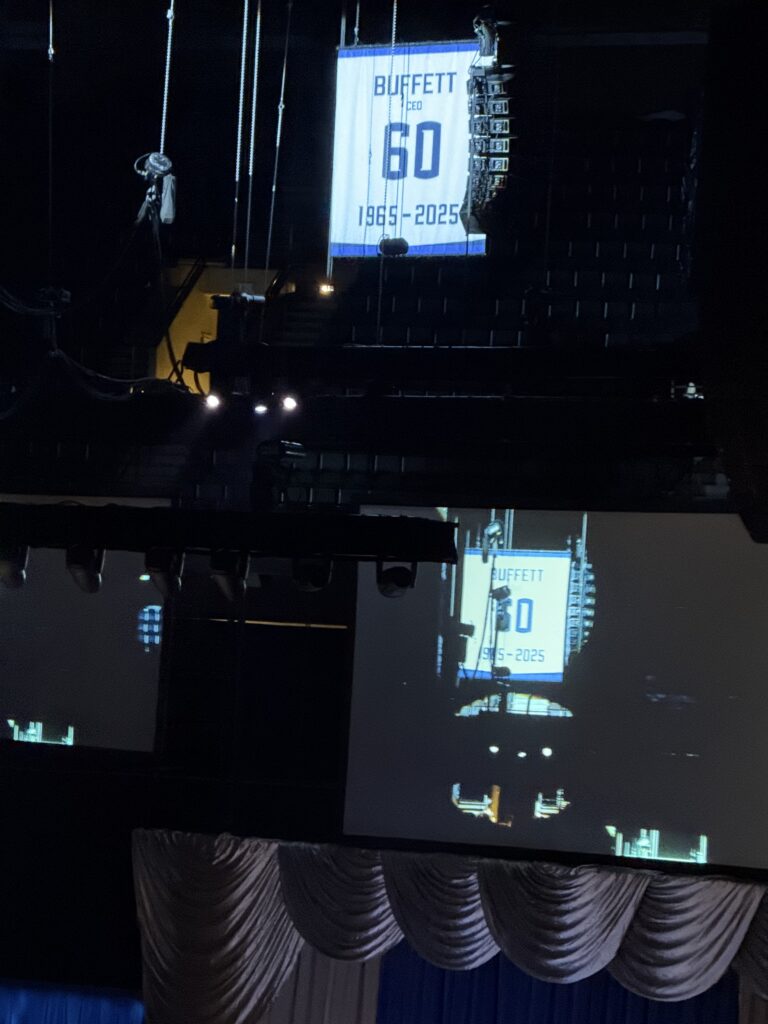
Buffett has stepped down as CEO, but he remains Chairman of the Board. When Greg Abel introduced him, he announced that the number 60 would be raised permanently to the rafters at CHI Health Center in recognition of Warren’s 60 years as Berkshire’s CEO. The audience gave Buffett a standing ovation.
We also learned that the table on stage included a Cherry Coke in Buffett’s honor, peanut brittle in honor of Charlie Munger, and Buffett’s chair, which remained unused.
The symbolism mattered. Berkshire has entered a new chapter, but it has not turned its back on the people and principles that shaped it.
7. Reputation is worth protecting.
Although it happened nearly 35 years ago, the meeting included a video of Warren Buffett’s September 1991 testimony before the House Subcommittee on Telecommunications and Finance following the Salomon Brothers Treasury auction scandal.
Buffett was Salomon’s interim chairman at the time. His testimony is widely regarded as a masterclass in crisis management and corporate ethics, particularly because of its focus on preserving reputation.
Buffett made one of his most iconic quotes during this testimony: “Lose money for the firm, and I will be understanding; lose a shred of reputation for the firm, and I will be ruthless.”
The testimony signaled a cultural shift that prioritized integrity over short-term corporate profits. That principle has remained central to Buffett’s approach throughout his career. Abel called this testimony “Berkshire’s anthem.”
The lesson applies well beyond business. Money can be rebuilt. Trust is much harder to restore.
8. Technology creates new risks to trust.
The first audience question during the Q&A came from “Warren from Omaha.” It was clear that Buffett was not speaking live, but I was not immediately certain whether we were watching a recording or an AI-generated video.
It was AI.
The question addressed why someone might hold Berkshire shares for the long term. Abel said Berkshire used the AI-generated Buffett question to remind everyone of the need to protect against cyber, fraud, and trust-related risks.
We also learned that Berkshire is currently sitting on the sidelines in cyber insurance because prices have been coming down. The company expects to play a larger role in the future.
The broader planning point is simple: as technology improves, verification matters more. Trust remains essential, but it must be supported by good systems and healthy skepticism.
9. The ability to say no is underrated.
I particularly appreciated Ajit Jain’s comments on Berkshire’s insurance business. They exemplified the company’s discipline in writing policies.
Jain emphasized how difficult it is to do nothing when everyone else is acting. He also stressed the importance of saying no.
Many people struggle to say no in both their personal and professional lives. That failure leaves us overextended. We say yes to too many commitments, too much complexity, too many possessions, too many obligations, and sometimes too much financial risk.
A good financial plan should help you say no with more confidence.
When you understand what matters most, you can better align your TEAM of capital (Time, Energy, Attention, and Money) with the life you want to live.
10. Structure should serve purpose.
Many have wondered whether Berkshire would pursue a spin-off or other major transaction now that Buffett is no longer CEO.
Abel addressed this directly. He said Berkshire is a conglomerate, but an efficient conglomerate. The company’s ability to move capital efficiently and to self-fund its businesses’ needs remains one of the key benefits of Berkshire’s structure. The float generated by Berkshire’s insurance businesses provides significant investment capital.
Berkshire does not have layers of bureaucracy and costs. It may dispose of businesses when appropriate, but shareholders should not expect a sum-of-the-parts transaction.
That is a useful planning lesson, too. Structure matters. But structure should serve purpose. Whether we are talking about a company, a portfolio, an estate plan, or a financial life, complexity only helps when it supports what matters.
You can stream the full 2026 Berkshire Hathaway annual shareholders’ meeting on YouTube.
Final Thoughts
This year’s Berkshire meeting reminded me that transitions reveal what really matters.
When familiar voices are no longer leading the conversation, culture, values, and stewardship matter even more. That is true for companies. It is also true for families and individuals navigating a new chapter.
Investing principles such as patience, discipline, reputation, and thoughtful capital allocation have obvious financial value. But they also apply to life planning.
The question is not only how to manage your money. It is how to use your resources, your Time, Energy, Attention, and Money, in support of the life you want to build.
If you would like to discuss how life planning and investing can work together in your financial life, please feel free to schedule a complimentary call.
A Few Common Questions About the Berkshire Hathaway Annual Shareholders Meeting
1. What made the 2026 Berkshire Hathaway annual shareholders meeting different?
The 2026 meeting marked a new chapter for Berkshire. Greg Abel led the meeting for the first time as CEO, while Warren Buffett remained Chairman. The meeting focused more on Berkshire’s businesses, operating discipline, capital allocation, and future than on the broader personal wisdom many attendees associated with Buffett and Charlie Munger.
2. Why does the Berkshire Hathaway annual shareholders meeting matter to investors?
The meeting gives shareholders a closer look at Berkshire’s culture, leadership, businesses, and long-term approach to capital allocation. For many long-time attendees, it has also offered lessons about patience, reputation, judgment, and stewardship.
3. What planning lessons can individuals take from Berkshire Hathaway’s transition?
Berkshire’s transition is a reminder that culture, values, discipline, and stewardship matter most when familiar voices are no longer leading the conversation. The same is true in personal financial planning. A good plan should help align your Time, Energy, Attention, and Money with the life you want to build.
Disclosure: I own Berkshire Hathaway shares personally. Some Apprise client portfolios that include individual stocks may also own Berkshire Hathaway shares. This post is for educational purposes only and should not be interpreted as a recommendation to buy, sell, or hold Berkshire Hathaway shares.
Our practice continues to grow through introductions from our clients and friends. Thank you for your trust.
If you would like to discuss financial topics, including navigating new beginnings, managing your investments, creating a life plan, or saving for retirement, please schedule a call or a Zoom virtual meeting. We will be in touch.
Follow us:
Facebook | LinkedIn | Instagram | YouTube | Substack
Please note: We post information about articles that can help you make better money-related decisions on Facebook, LinkedIn, Instagram, and YouTube. You can subscribe to have articles delivered to you via Substack.

For firm disclosures, see here: https://apprisewealth.com/disclosures/
Phil Weiss founded Apprise Wealth Management, where he works with women facing new beginnings. He started his financial services career in 1987 working as a tax professional for Deloitte & Touche. For the past 25 years, he has worked extensively in the areas of personal finance and investment management. Phil is a CFA charterholder, a CPA, and an RLP®.