
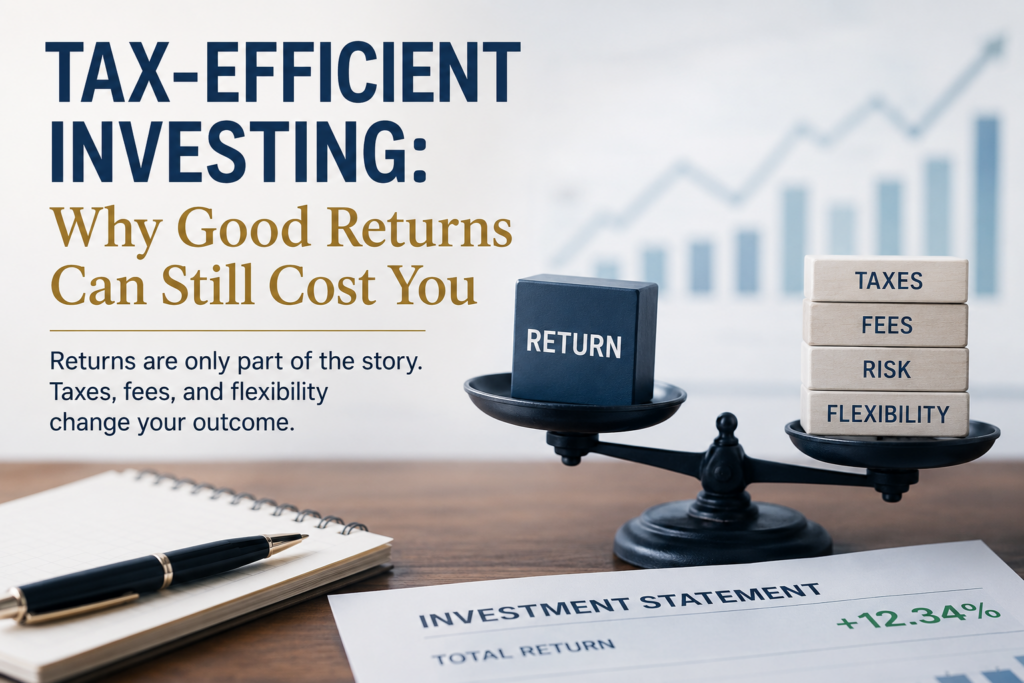
If your investment portfolio has performed well, it is natural to assume your investment strategy is working.
Sometimes it is.
But returns tell you only part of the story.
An investment portfolio can generate strong returns while also creating tax bills you may not expect, charging more than you realize, limiting your flexibility, or making future financial decisions harder.
Those costs do not always appear prominently on an investment statement. Some may not become obvious until years later.
That is one reason tax-efficient investing matters. Performance alone does not tell you whether an investment decision improved your financial outcome.
The better question is not simply:
How much did my investments earn?
It is:
What did those investment decisions actually accomplish for me after considering taxes, fees, risk, and the rest of my financial life?
Key Points
|
An Expensive Investment Can Become Hard to Fix
Consider a portfolio that includes unit investment trusts with significant charges or mutual funds with annual expenses well above those of comparable lower-cost investments.
Take something as straightforward as an S&P 500 mutual fund.
For example, one S&P 500 mutual fund’s Class A shares have an annual expense ratio of 0.54%, including a 0.24% 12b-1 fee. The Class A shares also carry a maximum front-end sales charge of 4.5%, although the actual sales charge may be lower or qualify for a waiver depending on the circumstances.
For comparison, a low-cost S&P 500 ETF has an annual expense ratio of 0.03%. Both funds seek to track the S&P 500.
The difference in annual expenses is 0.51 percentage points.
That may not sound like much. But at a $1 million balance, the difference equals about $5,100 in annual fund expenses.
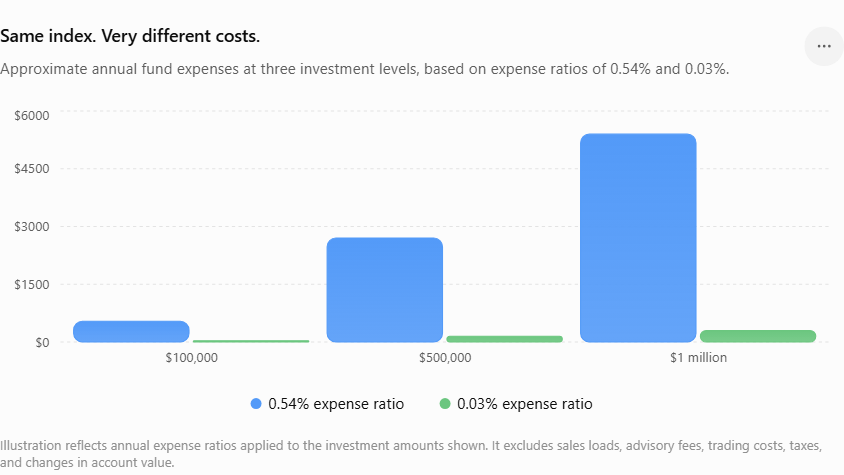
The dollar amount will change as the portfolio value changes, but the cost gap persists as long as the difference in expense ratios remains.
And remember, this comparison considers only the annual expense ratios. It does not include any sales charges or other costs that may apply.
The cheapest investment is not automatically the best investment. Higher costs may reflect different services or distribution arrangements. But investors should understand what they are paying for and whether they receive sufficient value in return.
But when two funds seek to provide substantially similar exposure to the same index, paying significantly more deserves scrutiny.
But cost is only the first issue.
What If Selling the Expensive Investment Creates Another Problem?
Suppose you discover that an investment is more expensive than necessary.
The obvious response might be:
Sell it and buy something cheaper.
But good financial planning rarely works that way.
Imagine you have owned the investment for many years and its value has increased substantially. Selling it now could trigger a large capital gain and an immediate tax bill.
Suddenly, the choice is no longer between an expensive mutual fund and an inexpensive ETF.
It is between continuing to pay higher annual expenses and potentially creating a significant tax liability today.
That is where tax-efficient investing becomes more than simply choosing investments with low costs or low turnover.
For an investor who expects to leave the asset to heirs, estate planning can further complicate the decision. Under current federal tax law, the basis of inherited property is generally adjusted to its fair market value at death, subject to certain exceptions. Depending on the investor’s circumstances, realizing a large gain during life merely to replace an expensive investment may not make sense.
That does not necessarily mean doing nothing.
It means you need a strategy.
You might gradually reduce the position over time. You might use the holding to fund future withdrawals. If you have them, you might offset gains with losses elsewhere in the portfolio. If charitable giving already fits your plan, donating appreciated shares may offer another option. Or you might conclude that continuing to hold some or all of the investment is the better financial decision.
The important lesson is this:
Investment decisions affect your future flexibility.
Costs matter when you buy an investment. Taxes can matter when you eventually want to change it.
Strong Returns Can Still Produce a Poor Tax Outcome
Now suppose an investor has enjoyed strong returns in a taxable account. Frequent sales have also generated substantial realized gains, most of them short-term, even though the investor did not need the proceeds for spending or another financial goal.
That changes the picture.
You generally pay taxes on net short-term capital gains at ordinary federal income tax rates rather than the preferential rates that can apply to net long-term capital gains. State income taxes may add another layer.
Strong returns can therefore coexist with a significant tax bill.
This is another reason tax-efficient investing needs to be part of portfolio management.
The investor still needs cash to pay the resulting tax. If sufficient cash is not available outside the portfolio, raising it may require additional sales, which can generate still more taxable gains. A sale creates a tax bill, and raising cash to pay it can potentially create more tax.
None of this means realizing a short-term gain is always wrong.
Sometimes selling is absolutely appropriate.
An investment may have become too risky. The original investment thesis may have changed. You may need (or want) to reduce a concentrated position. The portfolio may require rebalancing. You may need cash to cover your spending. Or the potential downside of continuing to hold an investment may outweigh the tax consequences of selling it.
Taxes should influence investment decisions.
They should not control them. As my college tax professor told us, “Don’t let the tax tail wag the dog.”
But you should usually consider taxes before the trade occurs.
Investment Return and Financial Outcome Are Not the Same Thing
This distinction is easy to overlook.
Investment return does not equal financial outcome.
Suppose one portfolio earns 12%.
Another earns 11%.
At first glance, the first portfolio looks better.
But what if earning 12% required substantially more risk?
What if it generated significant short-term capital gains?
What if its investments carried substantially higher expenses?
What if the additional taxable income raised future Medicare premiums or reduced your flexibility to pursue a Roth conversion or another tax-planning opportunity?
Now the comparison becomes much more complicated.
The highest return does not necessarily produce the best result.
This is one of the central ideas behind tax-efficient investing. The goal is not to avoid taxes at all costs. It is to consider after-tax results as part of the broader financial outcome.
What ultimately matters is not just what your investments earn.
It is what you get to keep and what your money allows you to do.
Taxes Are Part of Investment Management
People often treat investing and tax planning as separate subjects.
I do not think they should be.
Before making a meaningful trade in a taxable investment account, several questions are worth considering:
- Why are you selling this investment?
- How large is your unrealized gain or loss?
- Have you held the position long enough to qualify for long-term capital-gain treatment?
- What is your marginal tax rate?
- Do you have losses elsewhere that could offset the gain?
- Do you need cash?
- Could the additional income affect Medicare premiums or other income-based planning considerations?
- Is there another way to accomplish the same investment objective?
- Would spreading the transaction across more than one tax year make sense?
- How does the decision fit with your estate or charitable plans?
Sometimes the answer will still be:
Sell it.
But the trade should ideally follow the analysis, not come before it.
That is tax-efficient investing in practice. Taxes become one input into the decision rather than something you discover after the trade has already occurred.
Five Questions Worth Asking About Your Portfolio
Whether you work with an adviser or manage your investments yourself, consider asking these questions.
1. Do I know what my investments actually cost?
Do not stop with the advisory fee.
Look at the expenses of the underlying investments, sales charges, 12b-1 fees, transaction costs, and other charges that may apply.
2. How much taxable trading is taking place in my portfolio?
Turnover is not inherently bad.
But you should understand why trades are occurring and what tax consequences they create.
3. Do tax consequences factor into my sell decisions?
That does not mean avoiding every taxable gain.
It means understanding the cost before you decide to sell.
4. Does my investment strategy support my financial plan?
Your portfolio should account for spending needs, taxes, charitable giving, estate planning, retirement income, risk tolerance, and other financial priorities.
That coordination is critical to tax-efficient investing.
5. If I wanted to change my portfolio today, what would make that difficult?
Large embedded gains, concentrated positions, illiquid investments, surrender charges, or other constraints can all reduce your options.
You do not want to discover those limitations only when you need to make a change.
Frequently Asked Questions
1. What is tax-efficient investing?
Tax-efficient investing means considering tax consequences as part of investment decisions, which can improve your after-tax outcome.
It can involve managing capital gains, considering holding periods, harvesting losses when appropriate, choosing tax-efficient investments, coordinating which assets you hold in which account types, and considering taxes before making portfolio changes.
Tax efficiency should not override investment fundamentals. Risk, diversification, liquidity, expected return, and your financial goals still matter.
2. Are ETFs always more tax-efficient than mutual funds?
No.
ETFs often have structural advantages that can reduce taxable capital-gain distributions, and index ETFs frequently have relatively low turnover. But an ETF is not automatically tax-efficient, and a mutual fund is not automatically tax-inefficient.
The fund’s strategy, turnover, distributions, costs, and how you use the investment all matter.
3. Should I avoid selling an investment if I have a large capital gain?
Not necessarily.
Taxes are one factor in the decision. An investment may expose you to too much risk, no longer fit your portfolio, or need to be sold for another reason.
The important step is to understand the tax consequences and evaluate alternatives before selling.
Sometimes paying the tax is clearly worth it.
Other times, gradually reducing a position, using charitable giving strategies, offsetting gains with losses, or waiting may produce a better overall result.
4. Why do short-term capital gains matter?
If you hold an investment for one year or less, the IRS generally treats the gain as short-term. After you net applicable gains and losses, you generally pay ordinary federal income tax rates on any net short-term capital gain.
Long-term gains can qualify for preferential federal capital-gain rates.
That difference can make the timing of an investment sale important, although taxes should never be the only reason to continue holding an investment.
Your Portfolio Has a Job to Do
Investment returns matter.
I spend a great deal of time thinking about investment strategy, diversification, risk, and portfolio construction.
But your portfolio does not exist to win a performance contest.
It exists to support your financial life.
It should help fund your spending, preserve flexibility when circumstances change, support the people and causes that matter to you, manage risk, and help you make thoughtful decisions about how to use your money.
Sometimes accepting a tax bill is the right decision. Sometimes avoiding or deferring one produces a better outcome. And sometimes keeping an investment you would not buy today makes more sense than selling it immediately.
Tax-efficient investing is about understanding those trade-offs, not looking at investment decisions in isolation.
So when you evaluate how your portfolio is doing, do not stop at the performance number on your statement.
Ask a bigger question:
Are my investments helping me create the financial outcome I actually want?
That answer may tell you much more than your return ever will.
Related Reading
If you would like to explore these issues further:
Fee Transparency: You May Be Paying More Than You Think
A closer look at mutual fund expenses, sales loads, 12b-1 fees, and other investment costs that can be easy to overlook.
Asset Location for Tax Efficiency
Learn how asset location strategies can enhance your investment portfolio’s tax efficiency.
Why Working With a Fiduciary Adviser Matters
Why the standard under which an adviser delivers financial advice can affect the recommendations you receive.
21 DIY Investing Mistakes That Can Cost More Than Advisory Fees
Why taxes, portfolio construction, behavior, and planning mistakes can matter more than simply minimizing advisory fees.
Are Your Investments, Taxes, and Financial Plan Working Together?
Your portfolio should work with your tax plan and broader financial plan, not against them. The question is not simply whether your investments have gone up. It is whether the decisions surrounding them help you keep more of what you earn, manage risk, preserve flexibility, and use your money in ways that support the life you want.
If you are not sure whether those pieces are working together, schedule a call with us. Sometimes a second look can reveal things an investment return alone never will.
Our practice continues to grow through introductions from our clients and friends. Thank you for your trust.
If you would like to discuss financial topics, including navigating new beginnings, managing your investments, creating a life plan, or saving for retirement, please schedule a call or a Zoom virtual meeting. We will be in touch.
Follow us:
Facebook | LinkedIn | Instagram | YouTube | Substack
Please note: We post information about articles that can help you make better money-related decisions on Facebook, LinkedIn, Instagram, and YouTube. You can subscribe to have articles delivered to you via Substack.

For firm disclosures, see here: https://apprisewealth.com/disclosures/

Phil Weiss founded Apprise Wealth Management, where he works with women facing new beginnings. He started his financial services career in 1987 working as a tax professional for Deloitte & Touche. For the past 25 years, he has worked extensively in the areas of personal finance and investment management. Phil is a CFA charterholder, a CPA, and an RLP®.