

After a major life change, your financial life can feel louder. Bills, forms, accounts, deadlines, and other people’s questions can make every financial task feel urgent.
Some of those decisions really do matter now.
Some can wait.
Some should not sit on your shoulders alone.
The hard part is knowing the difference.
That is why the first 90 days after a major life change should not be about solving everything. They should be about creating stability, avoiding permanent mistakes, and building enough clarity for better long-term decisions.
Whether you are recently divorced, newly widowed, approaching retirement, leaving a job, or facing another major transition, the order of your decisions matters.
Good financial planning after a major life change is not only about asking, “What should I do?”
It is also about asking:
What needs attention now?
What should wait?
Where do I need more help?
Financial planning after a major life change can help you put those decisions in the right order.
Key Points
|
The value is not in making a longer to-do list. The value is knowing which decisions belong at the top of the list, which ones deserve more time, and which ones require help before you act.
Why the First 90 Days Feel So Overwhelming
A major life change can break the system you were using before.
The household budget may no longer fit. The way you pay bills may need to change. Income may be different. Account access may be unclear.
Insurance, taxes, beneficiary designations, Social Security, pensions, retirement accounts, and estate documents may all need attention.
At the same time, you may be grieving, angry, relieved, exhausted, anxious, or unsure of what comes next.
That emotional load matters. Financial decisions are harder when they are attached to loss, safety, family, identity, or independence.
A major life change does not just change your finances. It can change what your finances are for.
Before, your money may have supported a shared household, a career, a family rhythm, or a long-standing plan. Now it may need to provide stability, flexibility, confidence, or permission to live differently.
That is why financial planning after a major life change should not start with a completely new plan on day one. It should start with a better order of operations.
The Mistake: Treating Every Decision Like It Is Urgent
After a major life change, urgency and importance can get tangled together.
Some decisions are urgent because they protect you.
Others feel urgent because uncertainty is uncomfortable.
That difference matters.
For example, paying bills is urgent. Understanding your cash flow is urgent. Confirming that you can access key accounts is urgent.
But selling the house, changing your entire portfolio, making large gifts to children, retiring immediately, or committing to a new lifestyle may not need to happen right away.
Those decisions may be important. They may even become necessary. But important does not always mean immediate.
One of the biggest risks in the first 90 days is making permanent decisions while you are still trying to find your footing.
That is especially true after divorce or widowhood. You may feel pressure to simplify everything quickly. You may want to reduce uncertainty. You may want your children to experience as little disruption as possible.
Those instincts are understandable. But they can also lead to decisions that are hard to unwind.
If you only skim this article, remember this: decide what protects stability, delay what is hard to reverse, and delegate what carries technical or emotional weight.
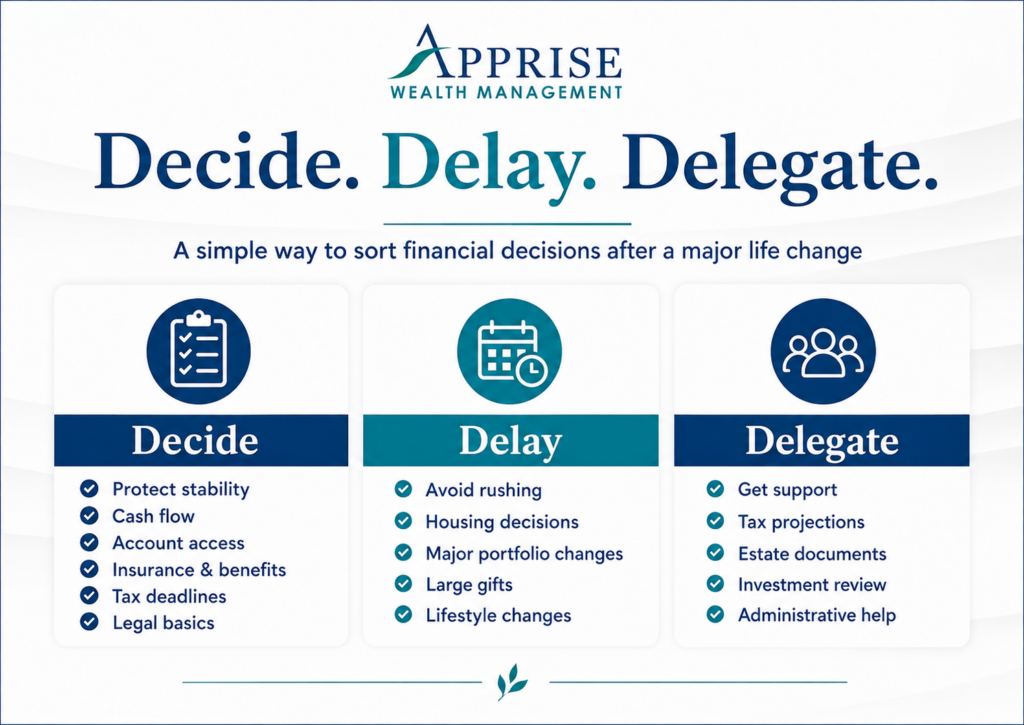
The 90-Day Framework for Financial Planning After a Major Life Change: Decide, Delay, Delegate
Decide: What Needs Attention Now
The first category is decide. These are the areas where waiting too long can create avoidable problems or unnecessary stress.
1. Cash Flow
Start with the basics.
How much money is coming in and from where?
What bills do you need to pay?
What expenses changed?
How much cash is available for the next few months?
This exercise is not about creating a perfect long-term budget. It is about knowing whether the near-term foundation is steady enough.
If income has fallen after divorce or the death of a spouse, this step becomes even more important. You may need to understand what is temporary, what is permanent, and where the pressure points are.
2. Account Access
Do you know where the accounts are?
Can you log in?
Are bills on autopay?
Whose name is on each account?
Are there accounts you cannot access?
This can be especially difficult after a spouse dies if one person handled most of the finances. It can also matter after divorce if you shared accounts, credit cards, loans, or household bills.
You do not need to reorganize everything immediately. But you do need to know what exists and how to access it.
3. Insurance and Benefits
Health insurance, life insurance, employer benefits, survivor benefits, disability coverage, Medicare, and COBRA can all become important after a transition.
Some benefits have deadlines, some can lapse, and some may need replacing.
This is an area where delay can create real risk. If coverage depends on your spouse, former spouse, employer, or previous household structure, put this near the top of the list.
4. Taxes
A major life change can change your tax picture. Your filing status may change. You may need to adjust withholdings or estimated tax payments.
Selling assets could trigger capital gains.
Retirement withdrawals could increase taxable income.
A Roth conversion, pension decision, or large account distribution could affect more than one tax year.
You do not need to become a tax expert. But before you make a major financial move, you should understand the tax consequences.
5. Legal Authority and Beneficiaries
After divorce, widowhood, or another major transition, beneficiary designations and estate documents may no longer reflect what you want.
Review:
- IRA and retirement account beneficiaries
- Transfer on death designations
- Life insurance beneficiaries
- Powers of attorney
- Health care directives
- Wills and trusts
Some changes may require an attorney. But even before documents are updated, you can list what needs review.
Delay: What Usually Does Not Need to Be Decided Immediately
The second category is delay.
Delay does not mean avoid.
It means give certain decisions enough space so you are not making them only from fear, guilt, grief, or pressure.
1. Whether to Keep or Sell the House
This may be the hardest decision for many people after divorce or widowhood.
The house is not just a financial asset. It holds memories, represents stability, and may feel like the last familiar place after everything else has changed.
If children are involved, the pressure can feel even greater. You may want to keep the house because you do not want their lives to change more than they already have.
That desire comes from love. But love does not make a house affordable.
A house can be the largest asset on the balance sheet and still create cash-flow stress. It may not generate income, but it still requires mortgage payments, property taxes, insurance, repairs, utilities, and maintenance.
Keeping the house can feel like protecting the family. Sometimes it does. Other times, it can leave someone house poor, with too much money tied up in walls and not enough available for daily life, retirement, emergencies, or peace of mind.
This is not an argument to sell the house quickly. It is an argument not to decide emotionally or in isolation.
Before deciding, ask:
Can I afford this house on my new income?
What does it cost each month, including maintenance, repairs, and taxes?
How much of my net worth sits in the house?
What would keeping it mean for retirement, savings, and flexibility?
What would selling it make possible?
And if you are keeping the house mostly for the kids, ask one more hard question:
Is staying in this house truly what they need most?
In many cases, children may care less about staying in the same house than we fear. What they often need most is a steady, present, loving parent who is overwhelmed by financial stress.
That does not make the housing decision easy. But it can help make the decision more honest.
2. Major Portfolio Changes
After a life change, simplifying your investments may sound appealing. But selling holdings, consolidating accounts, or shifting risk without a plan can create taxes, reduce flexibility, or lock in choices that do not fit your new circumstances.
Before making major portfolio changes, consider reviewing your cash needs, tax picture, time horizon, and risk capacity.
3. Large Gifts or Family Commitments
Helping children or other family members can be meaningful. But after a major life change, your own financial foundation needs attention first.
Do not commit to large gifts, loans, tuition support, home assistance, or ongoing family help before understanding your new long-term picture.
Generosity works best when it is sustainable.
4. Permanent Lifestyle Decisions
Moving, retiring fully, quitting work, buying a second home, or making a major spending commitment may all be appropriate eventually. But these choices deserve a clear head.
Waiting is not the same as avoiding.
Sometimes waiting is how you protect yourself from making a permanent decision in a temporary state of stress.
Delegate: What You Should Not Have to Carry Alone
The third category is delegate. Delegating does not mean turning over your life to someone else.
It means recognizing which decisions are too important, too technical, or too emotionally loaded to handle without support.
You can be capable and still need help. Those two things are not opposites.
Delegation may include:
- Asking a CPA to run a tax projection before selling assets or taking withdrawals
- Asking an estate planning attorney to review your legal documents
- Asking a financial advisor to evaluate retirement income, investments, insurance, and cash flow
- Asking a trusted person to help organize documents
- Asking for emotional support from a therapist, support group, or close friend
- Asking for administrative help with bills, passwords, or account inventory
The goal is not to give up control. It is to make better decisions with the right support around you.
What This Looks Like by Life Change
The decide, delay, delegate framework can apply to many transitions, but the pressure points are not always the same.
-
After Divorce
After divorce, cash flow, housing, insurance, account division, taxes, and beneficiary changes often move to the front of the line.
You may need to decide how to pay bills, whether your settlement creates enough liquidity, and whether your investment risk still fits your new life.
You may need to delay bigger lifestyle decisions, especially around the house, until you understand what you can comfortably afford on your own.
You may need to delegate tax projections, retirement account transfers, estate updates, or investment review.
-
After Widowhood
After the death of a spouse, the priority is usually stability.
Bills still need to be paid. Income sources may change. Survivor benefits, life insurance, pensions, Social Security, and account access may all need attention.
At the same time, many major decisions can wait. Selling the house, changing the portfolio, making large gifts, or deciding where to live long term may deserve more space.
Delegation can be especially valuable here. Not because you are incapable, but because grief and paperwork are a heavy combination.
-
Approaching or Entering Retirement
Near retirement, the questions often shift from accumulation to withdrawal.
You may need to decide how much cash to keep available, when to claim Social Security, how to coordinate Medicare, and which accounts to draw from first.
You may need to delay major portfolio moves until you understand how taxes, risk, and retirement income fit together.
You may need to delegate tax projections, withdrawal planning, Roth conversion analysis, and Medicare surcharge planning.
-
After a Career Change
A career change can affect income, benefits, retirement accounts, insurance, and cash reserves.
You may need to decide how long your cash runway needs to be, what to do with employer benefits, and whether to roll over a retirement account.
You may need to delay major spending commitments until your new income picture is clearer.
You may need to delegate benefits review, retirement account decisions, or tax planning around severance, equity compensation, or self-employment income.
-
After an Empty Nest or Caregiving Shift
Some life changes create more space rather than less. When children leave home, or caregiving responsibilities change, your schedule, spending, and sense of purpose may all shift.
You may need to decide what still fits, delay filling the calendar too quickly, and revisit how to use your Time, Energy, Attention, and Money more intentionally.
But every major transition deserves a fresh look at what your money is supposed to support now.
What This Looks Like in the First 90 Days
For financial planning after a major life change, here is a simple way to think about the first three months.
First 30 Days: Stabilize
Focus on what keeps life functioning.
- Pay essential bills.
- Confirm income sources.
- Identify key accounts.
- Gather important documents.
- Maintain insurance coverage.
- Avoid irreversible decisions unless necessary.
Days 31 to 60: Organize
Start turning the chaos into a clearer picture.
- Create an account inventory.
- Review cash flow.
- List insurance policies and benefits.
- Identify tax issues.
- Review beneficiaries.
- Separate urgent decisions from emotional pressure.
Days 61 to 90: Plan
Begin moving from reaction to intention.
- Decide what needs action.
- Delay what needs more clarity.
- Delegate technical or emotionally heavy decisions.
- Build the next version of your financial plan.
By the end of 90 days, you may not have every answer. That is fine.
The goal is not to finish everything. It is to regain enough control to make the next right decision.
What to Do Next
If you are in the first few months after a major life change, start by writing down every financial decision on your mind. If it’s easier, you can keep a running list in the notes app on your phone.
Do not organize it perfectly. Just get it out of your head.
Then put each decision into one of three categories: decide, delay, or delegate.
You do not need to solve everything today. You need a better order.
That is what good financial planning after a major life change can provide. It helps you stabilize what matters now, avoid rushing what deserves more time, and get support where the stakes are too high to guess.
Download
If you want a companion worksheet, I created a one-page download:
The First 90 Days Financial Reset
Use it to sort financial decisions after a major life change into three categories: what to decide now, what to delay, and where to get help.
FAQ
1. What should financial planning after a major life change focus on first?
Start with the decisions that protect stability. That usually means cash flow, bill payment, account access, insurance coverage, tax deadlines, and legal authority. You do not need to solve the rest of your life immediately.
2. What financial decisions should I avoid rushing after divorce or widowhood?
Avoid rushing decisions that are hard to reverse. This often includes selling or keeping the house, changing your entire investment portfolio, making large gifts, retiring immediately, or committing to a permanent lifestyle change before you understand your new financial picture.
3. How long should I wait before making major financial decisions?
It depends on the decision. Some issues require immediate attention. Others can wait until you have more clarity. The first 90 days are often best used to stabilize, organize, and separate what needs action from what deserves more time.
4. What is the difference between deciding and delegating financial choices?
Deciding means you own the choice. Delegating means you get help understanding the options, consequences, and tradeoffs. A good advisor, CPA, or attorney should help clarify the choices without taking away your control.
5. When should I get financial help after a major life change?
Consider getting help before acting on decisions that affect taxes, investments, retirement income, insurance, estate planning, or long-term cash flow. These areas often overlap, and one decision can affect several others.
Related Reading
- Financial Planning After a Major Life Change: The Old Permission System Breaks
- Before You Ask, “Do I Have Enough?” Ask This Instead
- 21 DIY Investing Mistakes That Can Cost You More Than Fees
- When a Roth Conversion Helps. And When It Doesn’t
- Identifying and Overcoming 6 Key Threats to a Woman’s Retirement
This post is educational information, not individualized investment, tax, or legal advice.
Our practice continues to grow through introductions from our clients and friends. Thank you for your trust.
If you would like to discuss financial topics, including navigating new beginnings, managing your investments, creating a life plan, or saving for retirement, please schedule a call or a Zoom virtual meeting. We will be in touch.
Follow us:
Facebook | LinkedIn | Instagram | YouTube | Substack
Please note: We post information about articles that can help you make better money-related decisions on Facebook, LinkedIn, Instagram, and YouTube. You can subscribe to have articles delivered to you via Substack.

For firm disclosures, see here: https://apprisewealth.com/disclosures/

Phil Weiss founded Apprise Wealth Management to help women facing new beginnings understand their financial lives, make thoughtful decisions, and use their money in ways that support what matters most to them.