
Career Change Financial Planning for Women
A career change can be energizing, scary, or both. The goal is to make the transition with clarity. Protect cash flow, plan for tradeoffs, and align work with the life you want.
If this is you, you’re in the right place
- You’re considering a new job, a new direction, or re-entering the workforce.
- You want to understand what you can afford to change.
- You want a plan that supports today and the long term.
- You want the financial side of the transition to feel steady, not chaotic.
What to do first
- Understand your runway: Cash flow, savings, and flexibility.
- Clarify the tradeoffs you’re willing to make: Pay, time, stress, purpose.
- Review benefits and insurance implications before you make decisions.
- Build a simple decision timeline to help you avoid feeling rushed.
What can usually wait
- Permanent decisions before your new routine is stable.
- Major purchases until you see the new cash flow in real life.
- Over-committing to a new identity before you test your assumptions.
Decisions that deserve extra care
- Health insurance, disability, and retirement plan changes.
- The tax impact of compensation changes, equity, or self-employment.
- Timing around big purchases, support obligations, or tuition planning.
How Apprise supports you through a career change
We help you make the transition with structure.
- Build a cash flow plan and analyze any resulting tradeoffs.
- Coordinate your benefits, savings strategy, and tax planning.
- Align work choices with what you want your life to feel like.
- Provide ongoing guidance as your transition unfolds and evolves.
Frequently Asked Questions
Start by understanding what the change could mean for your income, expenses, savings, benefits, and taxes. We can help you evaluate different scenarios so you can see what trade-offs may be involved and how much flexibility you have before deciding.
No single number works for everyone. The right amount depends on your expenses, expected income, how long the transition may take, and what other financial resources you have. Building some financial runway can give you more choices and reduce the pressure to decide quickly.
Compensation is only one part of the decision. Health insurance, retirement benefits, bonuses, equity compensation, paid time off, commuting costs, flexibility, and work hours can all affect the financial picture. It is also worth considering what the change means for your time, energy, and the life you want outside of work.
You may have several options, including leaving the money in your former employer's plan, moving it to a new employer's plan, or rolling it into an IRA. The right choice depends on factors such as investment options, fees, taxes, creditor protection, and your broader financial plan. You generally do not need to make this decision immediately.
Before leaving your current employer, understand when your existing coverage ends and what alternatives are available. Depending on your situation, those could include coverage through a spouse or partner, COBRA, or an individual policy. The cost and timing of coverage should be part of your career-change plan, not an afterthought.
Yes. A career decision does not have to be based solely on maximizing income. Financial planning can help you understand what a lower salary, reduced hours, or a different type of work could mean for your lifestyle and long-term plans, so you can decide which trade-offs you are comfortable making.
Moving from employee to self-employed can change your cash flow, taxes, insurance, and retirement benefits. It can help to estimate your personal and business expenses, build adequate reserves, understand tax obligations, and consider how you will replace benefits you previously received from an employer.
No. In many cases, planning is most useful while your options are still open. Understanding what your finances can support may help you evaluate different paths, identify constraints, and give yourself more room to explore before committing to a particular direction.
Two quick details
Do you offer hourly or one-time planning?
No. Apprise works with clients through an ongoing advisory relationship.
What is your minimum required fee to become a client?
We base our minimum fee on the scope of work and the ongoing relationship. In most cases, clients should expect a minimum annual fee of $8,000. We can clarify fit quickly on a discovery call.
If you want support
If you’re facing a career change and want clarity around your options and tradeoffs, schedule a discovery call.
Why Choose Us
INTEGRATED APPROACH
It is through detailed financial conversations encompassing all aspects of our clients’ lives that we empower people to make informed decisions.
ACCOUNTABILITY
PEACE OF MIND
At Apprise, we understand that short-term tactics can be important but they must be executed based upon wise strategic decisions rather than best-guess predictions.
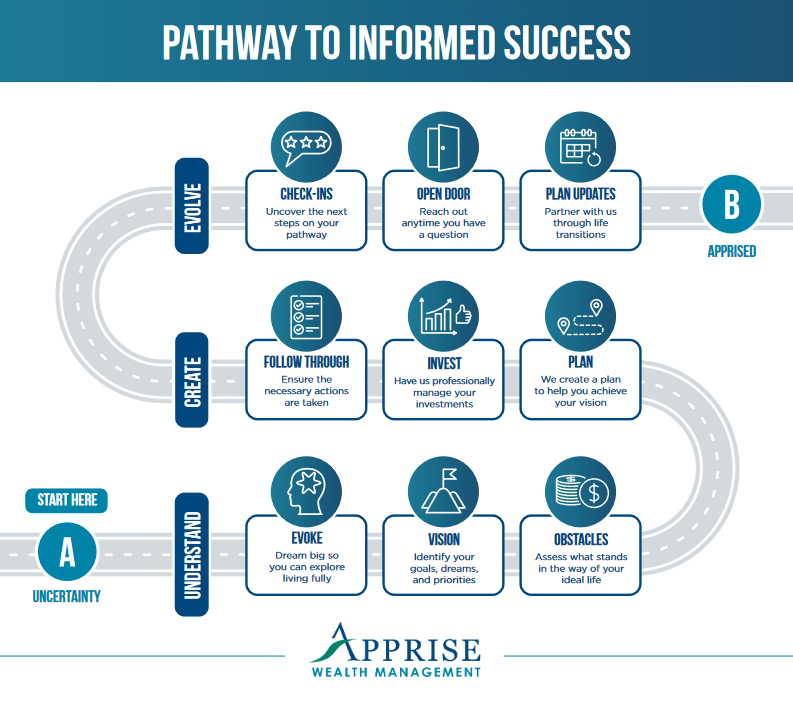
Pathway to Informed Success
14840 Hunting Way Phoenix, MD 21131
