

October through December is one of the busiest times of the year at Apprise Wealth Management. Why? Because tax planning plays an important role in the financial planning we do for our clients. Year-end tax planning plays an important role in the work we do for our clients.
During the fourth quarter, I spend much of my time reviewing tax projections, evaluating Roth conversions, adjusting retirement distributions and tax withholding, and identifying other opportunities before December 31.
These conversations aren’t just about reducing this year’s tax bill. They’re about making decisions today that can improve a client’s financial position over the rest of their life. That’s an important distinction. After all, not every strategy will lower your taxes this year. Some purposely focus on reducing how much you pay in taxes over your lifetime.
Sometimes, a good tax-planning decision reduces what you owe this year. Other times, it means deliberately paying more taxes today to reduce what you or your family may owe later.
I often remind clients that taxes and investing are joined at the hip. You shouldn’t let taxes drive every financial decision, but you shouldn’t ignore them either.
With roughly nine weeks left in 2026, you still have time to take meaningful action. But some opportunities will disappear after December 31.
Here are nine year-end tax-planning strategies worth reviewing before the calendar turns to 2027. Not every strategy will apply to you, so start with the decisions most relevant to your circumstances.
Key Takeaways
|
Jump to a Tax-Planning Strategy
1. Update Your Tax Projection and Withholding
2. Evaluate Roth Conversions, Even After RMDs Begin
3. Review Retirement Distributions, RMDs, and QCDs
4. Make Charitable Giving More Tax-Efficient
5. Maximize Workplace Retirement Contributions
6. Review IRA Contributions and Backdoor Roth Opportunities
7. Consider Tax-Loss and Tax-Gain Harvesting
8. Make the Most of Health Savings Accounts
9. Review the Tax Impact of Major Life Changes
Year-End Tax Planning Deadlines
1. Update Your Tax Projection and Withholding
Before deciding which tax-planning strategies to implement, it helps to know where you stand.
At Apprise, I prepare updated tax projections for essentially all clients taking distributions to support their retirement income. These projections help us estimate their annual tax liability and decide whether to make any changes before year-end.
For retirees, this typically involves reviewing income sources such as Social Security, pensions, IRA withdrawals, investment income, and other relevant items.
We also review deductions, tax payments already made, and amounts withheld from distributions.
The results may suggest several different actions.
If we expect a client to owe more than originally projected, we may increase withholding from upcoming distributions, adjust distribution amounts, or consider making an additional tax payment.
Alternatively, if we’ve withheld more than necessary, we may reduce withholding on remaining distributions. That doesn’t change the amount of tax ultimately owed, but it can improve cash flow.
We also consider whether a client has satisfied applicable estimated-tax-payment requirements. Because the IRS generally treats federal income tax withholding as paid evenly throughout the year, increasing withholding late in the year can sometimes help address an earlier estimated-tax-payment shortfall. For more information, see IRS Publication 505, Tax Withholding and Estimated Tax.
State income tax rules may differ. That’s why we review federal and state payment requirements separately when appropriate.
Of course, the appropriate action depends on the client’s circumstances.
Our goal isn’t to receive a large refund or owe nothing when filing a return. A large refund often means you’ve paid more in taxes than necessary throughout the year, effectively giving the government an interest-free loan.
Instead, we aim to manage tax payments thoughtfully and coordinate them with your broader financial plan.
For a more detailed discussion, see How to Pay Taxes in Retirement Without Making It Harder Than It Needs to Be.
2. Evaluate Roth Conversions, Even After RMDs Begin
Roth conversions represent one of the most frequently used tax-planning strategies at Apprise.
A Roth conversion involves transferring money or securities from a traditional IRA or another eligible pre-tax retirement account to a Roth IRA. You generally pay income tax on the converted amount in the year of conversion, but qualified future withdrawals from the Roth IRA are tax-free.
Why voluntarily pay taxes today?
Because doing so may reduce the amount of taxes you, your surviving spouse, or your beneficiaries pay in the future.
Roth Conversions Are Not Just for the Years Before RMDs
Many discussions of Roth conversions focus on the years between retirement and the beginning of required minimum distributions (RMDs). Those years can present particularly attractive opportunities because taxable income may be temporarily lower.
But Roth conversions can also make sense after RMDs begin.
To illustrate, consider a hypothetical married couple in their 70s with substantial traditional IRA balances. Both receive Social Security, and the household takes annual RMDs.
Based on their current income, a Roth conversion would create an additional tax liability. It might even push them across an Income-Related Monthly Adjustment Amount (IRMAA) threshold, increasing their Medicare premiums, generally two years later.
Why would they consider converting anyway?
Because we also want to understand what their financial picture might look like after the first spouse dies.
The surviving spouse may inherit most of the retirement assets, but the household will generally lose one Social Security benefit. After the year of death, the surviving spouse will typically file as single, with narrower tax brackets and different Medicare income thresholds.
For a surviving wife, who may have many years of retirement ahead, this can create a meaningful tax challenge.
By converting some traditional IRA assets while both spouses are living, the couple may reduce future RMDs and give the survivor greater flexibility over where retirement income comes from.
In some situations, paying more in income taxes today, and potentially higher Medicare premiums in a future year, may be preferable to leaving the surviving spouse facing substantially higher tax costs and Medicare premiums later.
The key question isn’t simply how much tax a conversion creates today. It’s whether the conversion is likely to improve the family’s long-term financial position.
One important rule: If you’re already subject to RMDs, you must satisfy your required distribution before converting additional eligible IRA funds. You can’t convert the RMD itself.
For a deeper discussion, see How Roth Conversions Can Help You, Your Surviving Spouse, and Your Heirs.
Why the SALT Deduction Can Put a Governor on Roth Conversions
When evaluating Roth conversions, I often consider how much income we can add before reaching a particular tax bracket. But in 2026, looking only at ordinary income tax brackets can be misleading.
The state and local tax (SALT) deduction provides an important example.
For 2026, taxpayers who itemize may deduct up to $40,400 of qualifying state and local taxes, subject to applicable limitations. However, the maximum SALT deduction begins to decrease when modified adjusted gross income (MAGI) exceeds $505,000 for taxpayers other than those filing married separately.
Above that threshold, the SALT deduction cap generally decreases by $0.30 for every additional dollar of MAGI until it falls to $10,000.
That means a household could lose up to $30,400 in potential SALT deductions.
For higher-income households, consider a couple with MAGI of $505,000 who itemizes deductions and pays enough qualifying state and local taxes to use the full $40,400 SALT deduction.
If they complete an additional $10,000 Roth conversion, their SALT deduction cap could decrease by $3,000.
As a result, the $10,000 conversion could increase taxable income by $13,000, assuming the couple remains limited by the SALT cap and no other factors change.
Assuming the couple remains in the 32% federal income tax bracket, the additional federal tax would be approximately $4,160. That’s an effective federal marginal tax rate of 41.6% on the $10,000 conversion, before considering other tax interactions.
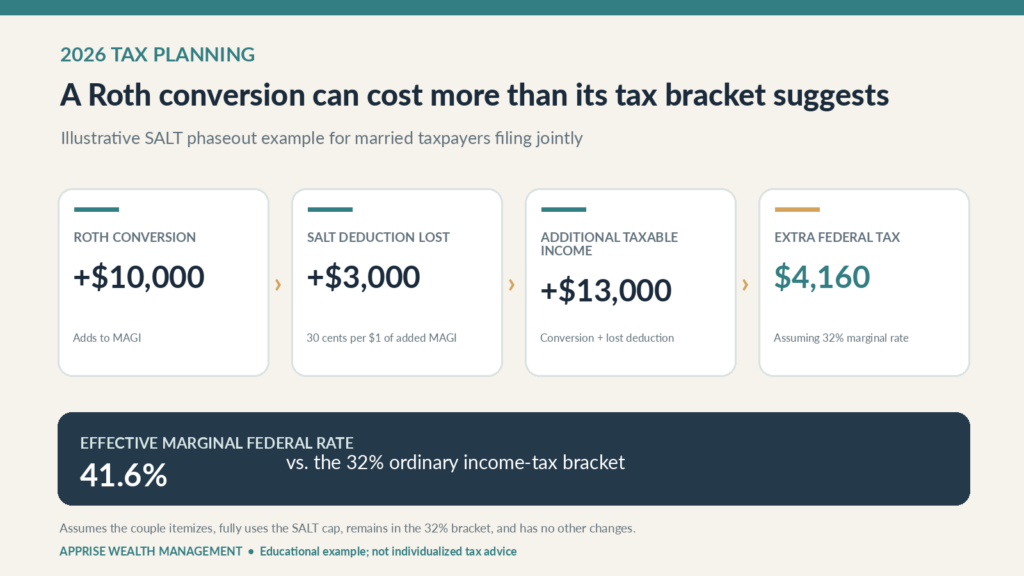
A conversion that initially appeared attractive based on the ordinary income tax bracket may now be considerably less appealing.
That doesn’t automatically mean we should avoid the conversion. However, the SALT phaseout can put a governor on how much we recommend converting in a given year.
The actual impact depends on whether you itemize, how much you pay in qualifying state and local taxes, and how the conversion interacts with other tax provisions.
Don’t Overlook the Senior Deduction Phaseout
Another important consideration in year-end tax planning is the enhanced senior deduction introduced in 2025.
For 2026, eligible taxpayers age 65 or older may claim an additional deduction of up to $6,000 per person. A married couple may qualify for up to $12,000 if both spouses are eligible.
However, the deduction begins to phase out when MAGI exceeds $75,000 for single filers or $150,000 for joint filers.
The deduction is reduced by 6% of excess MAGI for each eligible person.
For example, when both spouses qualify for the deduction, an additional $10,000 in income within the phaseout range can reduce their combined deduction by $1,200.
That increases the effective cost of a Roth conversion beyond the ordinary marginal tax rate.
Roth conversions can also increase the taxable portion of Social Security benefits, raise Medicare premiums through IRMAA, and affect other income-based tax provisions.
These interactions are why I believe Roth conversion decisions should start with a tax projection, rather than a simple desire to fill a particular bracket.
When Might a Roth Conversion Not Make Sense?
Despite their potential benefits, Roth conversions aren’t always appropriate.
A conversion may be less attractive if it creates a particularly high effective tax rate, if future retirement withdrawals are likely to face lower taxes, or if you expect to move to a state with lower income taxes.
We also consider how you’ll pay the conversion tax. Paying the taxes from funds outside the retirement account may make the conversion more attractive, but doing so shouldn’t compromise your cash reserves or other financial goals.
There is no requirement to complete a Roth conversion every year, nor is there a rule that says you must fill a particular tax bracket.
I prefer evaluating the opportunity annually, based on the client’s current circumstances and projected future needs.
For additional perspective, see When a Roth Conversion Helps and When It Doesn’t.
3. Review Retirement Distributions, RMDs, and QCDs
If you’re retired, year-end tax planning should include a review of your retirement-account distributions.
For those subject to RMDs, the first question is straightforward: Have you satisfied your required distribution for 2026?
How clients satisfy this requirement varies.
Some take monthly IRA distributions to support their living expenses. Others take periodic withdrawals during the year. Still others wait until the fourth quarter to satisfy their RMD.
Except for certain first-year situations, RMDs generally must be completed by December 31.
We also consider whether additional distributions are appropriate. Depending on your projected income and future tax position, withdrawing more than the required amount may make sense.
This issue is especially important for beneficiaries who inherited traditional IRAs in 2020 or later and must empty those accounts within ten years. Spreading withdrawals across several years may help avoid a large taxable distribution in the final year. The applicable annual distribution requirements depend on the original owner’s age at death and the beneficiary’s status.
Qualified Charitable Distributions
For charitably inclined IRA owners age 70½ or older, qualified charitable distributions (QCDs) can be particularly valuable.
A QCD allows you to transfer money directly from an eligible IRA to a qualifying charity. If the distribution satisfies IRS requirements, you can exclude the amount from taxable income.
For 2026, the annual QCD exclusion limit is $111,000 per eligible taxpayer.
A QCD can also satisfy some or all of an RMD, provided you haven’t already satisfied that portion of your required distribution.
Timing matters. If you’ve already taken your full RMD for the year, a subsequent QCD won’t retroactively replace it. The QCD may still qualify for exclusion from income, but it won’t reduce the taxable income from the RMD you previously received.
Some Apprise clients use QCDs throughout the year, including monthly donations. Others prefer to complete them in the fourth quarter.
Because you exclude QCDs from income, they can sometimes provide a greater tax benefit than taking a taxable IRA distribution and then donating the proceeds.
QCDs may also reduce the taxable portion of Social Security benefits or help limit exposure to income-based provisions such as IRMAA.
They can also benefit taxpayers who itemize medical expenses. Because those expenses are deductible only to the extent they exceed 7.5% of adjusted gross income (AGI), excluding an otherwise taxable IRA distribution through a QCD can increase the amount of medical expenses eligible for a deduction.
A note of caution: You cannot direct QCDs to donor-advised funds, and you cannot claim a separate charitable deduction for the amount excluded from income.
The broader point is that you shouldn’t consider retirement distributions and charitable giving independently.
4. Make Charitable Giving More Tax-Efficient
If charitable giving is important to you, the source and timing of your contributions can materially affect their tax benefits.
Several strategies remain worth considering.
Donate Appreciated Securities
Donating appreciated securities directly to an eligible charity generally allows you to avoid recognizing the embedded capital gain. However, the holding period affects the potential charitable deduction.
For securities held longer than one year, the deduction generally equals their fair market value, subject to applicable limitations. For securities held one year or less, the deduction is generally limited to their cost basis.
Although avoiding short-term capital gains can be valuable because they’re generally taxed at ordinary income rates, the reduced charitable deduction can offset that benefit.
When deciding what to give, compare donating appreciated securities directly with selling the securities and donating the proceeds. The more tax-efficient approach depends on the holding period, applicable tax rates, and deduction limitations.
For further information, see Where Should Your Charitable Gift Come From? Cash, Appreciated Stock, or a Qualified Charitable Distribution.
Consider Bunching Charitable Contributions
Bunching involves combining multiple years of charitable contributions into one tax year.
Instead of making the same contribution every year, you may make a larger donation in one year, itemize deductions in that year, and take the standard deduction in other years.
A donor-advised fund (DAF) can support this strategy. You make an irrevocable contribution to the DAF, potentially receive a deduction in the contribution year, and recommend grants to charities over time.
Two Important Charitable Deduction Limitations in 2026
Starting in 2026, taxpayers who itemize generally can deduct charitable contributions only to the extent their qualifying contributions exceed 0.5% of adjusted gross income.
For example, suppose your AGI is $200,000, and you donate $10,000 to charity.
The first $1,000, representing 0.5% of AGI, is not deductible under the new floor. That leaves a potential $9,000 charitable deduction, subject to any other applicable limitations.
An additional limitation can reduce the tax benefit of itemized deductions for higher-income taxpayers.
Known as the 2/37 limitation, this rule can reduce the value of itemized deductions when income before those deductions exceeds the threshold for the highest federal income tax bracket (37%). When the full limitation applies, each dollar of otherwise allowable itemized deductions generally yields a maximum federal income tax benefit of 35 cents, not 37 cents.
The limitation applies to itemized deductions generally, not just charitable contributions. For 2026, the relevant income thresholds are $768,700 for married couples filing jointly and $640,600 for single taxpayers. The calculation can affect taxpayers even when their taxable income after itemized deductions falls below those thresholds.
Together, these changes make the timing and type of charitable contributions more important.
They also provide another reason to consider QCDs when eligible, since qualifying QCDs are excluded from income rather than claimed as itemized deductions.
Charitable contributions can also affect Roth conversion decisions. For example, increasing AGI through a Roth conversion raises the 0.5% charitable deduction floor, potentially increasing the conversion’s effective tax cost.
A New Deduction for Non-Itemizers
Taxpayers who don’t itemize also benefit from a favorable change.
Beginning in 2026, eligible taxpayers can deduct up to $1,000 in qualifying cash charitable contributions, or $2,000 for married couples filing jointly, even when claiming the standard deduction.
The deduction doesn’t apply to all types of charitable contributions or recipients, including donor-advised funds.
For more information, see 2026 Tax Changes: What Actually Matters.
5. Maximize Workplace Retirement Contributions
If you’re still working, you may be able to reduce your current-year taxable income by increasing pre-tax contributions to your workplace retirement plan.
For 2026, the employee contribution limit for most 401(k) and 403(b) plans is $24,500.
If you’re age 50 or older, the regular catch-up contribution limit is $8,000, bringing the total to $32,500.
For employees ages 60 through 63, the catch-up contribution limit is higher at $11,250, allowing eligible contributions totaling $35,750.
If you haven’t reached your contribution limit, review whether you can increase your contributions during your remaining 2026 pay periods.
If your employer offers matching contributions, make sure you’re contributing enough to receive the full available match.
New Roth Catch-Up Rules
Beginning in 2026, employees whose 2025 FICA wages from the employer sponsoring their retirement plan exceeded $150,000 generally must make their 2026 catch-up contributions on a Roth basis, provided the plan permits catch-up contributions.
Because Roth contributions use after-tax dollars, they don’t provide the same current-year income tax reduction as pre-tax contributions.
If this rule applies to you, make sure your payroll elections and retirement savings strategy reflect it.
Also remember that your decision between pre-tax and Roth contributions should fit your broader financial and tax plan.
6. Review IRA Contributions and Backdoor Roth Opportunities
For 2026, the IRA contribution limit is $7,500, with an additional $1,100 catch-up contribution for eligible individuals age 50 or older.
Whether you can deduct a traditional IRA contribution or contribute directly to a Roth IRA depends on your income and other circumstances.
If you’re married and only one spouse has earned income, a spousal IRA contribution may also be available, subject to applicable requirements.
Backdoor Roth IRAs
Higher-income households that cannot contribute directly to Roth IRAs may want to consider a backdoor Roth IRA.
The strategy typically involves making a nondeductible contribution to a traditional IRA and then converting that amount to a Roth IRA.
However, the IRS pro-rata rules can make some or all of the conversion taxable if you have pre-tax balances in traditional, SEP, or SIMPLE IRAs.
These rules generally treat your eligible traditional IRA balances collectively, rather than focusing only on the account you’re converting. The calculation depends on December 31 account balances and any existing nondeductible IRA basis. Properly document nondeductible contributions and conversions on Form 8606.
For clients who regularly use this strategy, year-end is a good time to review whether they’ve completed their intended contributions and conversions.
Keep in mind that the deadlines differ.
Eligible 2026 IRA contributions generally can be made until April 15, 2027. However, Roth conversions count in the calendar year in which you complete them.
That means a conversion completed in 2027 is a 2027 tax event, even if the nondeductible contribution relates to 2026.
For further information about Backdoor Roth IRAs, see Wealth Unlocked: Navigating the Benefits of Backdoor Roth IRAs.
7. Consider Tax-Loss and Tax-Gain Harvesting
Your investment portfolio may also offer year-end tax-planning opportunities.
Tax-Loss Harvesting
If investments in a taxable account are worth less than you paid for them, you may be able to sell them and realize a capital loss.
Capital losses can offset realized capital gains. If your losses exceed your gains, you can generally deduct up to $3,000 of net capital losses against other income each year, carrying any remaining losses forward to future years.
You don’t necessarily need to abandon your investment strategy when harvesting losses.
For example, you might sell one diversified stock fund and purchase another fund with similar, but not substantially identical, investment exposure.
However, you must pay attention to the wash-sale rules. Buying substantially identical securities within 30 days before or after selling an investment at a loss can prevent you from deducting that loss immediately.
The rules can also apply to purchases involving a spouse’s account or an IRA. Be especially careful about repurchasing substantially identical investments in an IRA or Roth IRA. Unlike a typical taxable-account wash sale, the disallowed loss does not increase your IRA’s tax basis.
Tax-Gain Harvesting
The opposite strategy can also make sense.
If your taxable income places you in the 0% long-term capital gains bracket, you may be able to sell appreciated investments without paying federal capital gains taxes on some or all of the eligible gains.
For 2026, the 0% long-term capital gains bracket applies to taxable income up to $49,450 for single filers and $98,900 for married couples filing jointly. The amount of gain eligible for the 0% rate depends on your other taxable income.
Realizing gains at a 0% federal rate can increase the cost basis of investments and potentially reduce future taxes.
Unlike tax-loss harvesting, wash-sale rules don’t apply to gains.
However, a 0% federal capital-gains rate doesn’t necessarily mean realizing the gain has no tax consequences. State income taxes may still apply, and the additional income can affect the taxable portion of Social Security benefits or other income-based tax provisions.
Watch for Year-End Mutual Fund Distributions
If you’re considering purchasing a mutual fund in a taxable account before year-end, check whether the fund expects to make a capital-gains distribution. Many mutual funds distribute gains from securities they’ve sold during the year, often in December. You may owe taxes on those distributions even if you purchased the fund shortly beforehand or reinvested the proceeds. Because the fund’s share price generally declines by about the distribution amount, receiving it doesn’t create an equivalent economic gain.
Before investing, check the fund company’s website for estimated distribution amounts and dates. Depending on the circumstances, you may want to delay your purchase until after the distribution or consider a more tax-efficient alternative, such as an exchange-traded fund (ETF). Although ETFs can also distribute capital gains, many do so less frequently than traditional mutual funds. This concern primarily applies to taxable accounts rather than tax-deferred retirement accounts.
Make investment decisions that support your financial goals. Tax savings alone shouldn’t determine whether you buy or sell an investment.
8. Make the Most of Health Savings Accounts
Health Savings Accounts (HSAs) offer several valuable tax benefits.
If you’re eligible to contribute to an HSA, contributions are generally tax-deductible, investment earnings can grow tax-free, and withdrawals used for qualified medical expenses are tax-free.
These three tax advantages can make HSAs particularly valuable for long-term planning.
For 2026 and 2027, contribution limits are:
| Coverage | 2026 Contribution Limit | 2027 Contribution Limit | |
| Self-only | $4,400 | $4,500 | |
| Family | $8,750 | $9,000 | |
| Additional contribution, age 55+ | $1,000 | $1,000 |
To contribute, you generally must have HSA-eligible health coverage, satisfy the other eligibility requirements, and not be enrolled in Medicare.
If you’re working past age 65 and delaying Medicare enrollment, pay particular attention to the timing of your HSA contributions. Premium-free Medicare Part A coverage may begin retroactively, sometimes up to six months before enrollment, which can make contributions for those months ineligible.
Beginning in 2026, certain bronze and catastrophic health insurance plans also qualify as HSA-compatible coverage, expanding eligibility for some individuals who previously couldn’t contribute.
If you qualify, you generally have until April 15, 2027, to make contributions for the 2026 tax year.
For more detail, see my article, A Comprehensive Review of Health Savings Accounts.
9. Review the Tax Impact of Major Life Changes
Tax planning becomes particularly important when your life changes.
Retirement, divorce, widowhood, and other transitions can affect your filing status, deductions, income sources, and how you withdraw money from your accounts.
Consider someone who recently retired.
Her income may have fallen, creating an opportunity to evaluate Roth conversions or tax-gain harvesting. But her income could rise again when Social Security or RMDs begin.
Similarly, someone going through a divorce may need to review filing status, retirement account transfers, and the tax consequences of dividing investment assets.
For a widow, the shift from married filing jointly to single filing status can substantially change future taxes, even if household spending falls after her spouse’s death.
In the year a spouse dies, the surviving spouse can generally still file a joint federal income tax return, assuming they otherwise qualify. This may provide a final opportunity to use the married-filing-jointly tax brackets through Roth conversions or other tax-planning strategies.
In subsequent years, the surviving spouse will generally file as single unless they qualify for another filing status. For example, someone with a qualifying dependent child may be eligible for qualifying surviving spouse status for up to two years after the year of death, allowing them to continue using the married-filing-jointly tax brackets.
These decisions affect more than taxes. They influence cash flow, retirement security, housing choices, charitable giving, and the resources available to support the life you want to live.
That’s why I believe thoughtful tax planning belongs in a comprehensive financial plan, not as a separate annual exercise.
Which Year-End Tax Planning Deadlines Matter Most?
Not every strategy has the same deadline.
| Planning action | General deadline |
| Complete 2026 Roth conversions | December 31, 2026 |
| Realize capital gains or losses for 2026 | December 31, 2026 |
| Satisfy annual RMDs | December 31, 2026, with certain first-year exceptions |
| Complete 2026 QCDs | December 31, 2026 |
| Make most 2026 charitable contributions | December 31, 2026 |
| Make workplace salary deferrals for 2026 | By the applicable final 2026 payroll |
| Make eligible 2026 IRA contributions | Generally April 15, 2027 |
| Make eligible 2026 HSA contributions | Generally April 15, 2027 |
Although some deadlines extend into 2027, you shouldn’t assume that every tax-planning decision can wait.
Roth conversions, investment sales, charitable transfers, and retirement distributions may take time to process. Acting before the final days of December can help prevent avoidable problems.
Frequently Asked Questions About Year-End Tax Planning
1. Why should I review taxes before December 31 instead of waiting until tax season?
Tax preparation generally reports financial transactions that have already occurred. Tax planning helps you evaluate decisions before the relevant deadlines pass.
By updating projected income, deductions, and tax payments, you can identify opportunities that may no longer be available when you file your return.
2. Can a Roth conversion still make sense if I’m already taking RMDs?
Yes. You cannot convert an RMD itself, but you may convert other eligible IRA amounts after satisfying your required minimum distribution.
A conversion may help reduce future RMDs and provide greater tax flexibility for you, your surviving spouse, or your beneficiaries. However, you should consider the current tax cost, including Medicare IRMAA and applicable deduction phaseouts.
3. How can the SALT deduction phaseout affect a Roth conversion?
In 2026, the maximum SALT deduction begins to phase out once MAGI exceeds $505,000 for most filing statuses.
Within the phaseout range, each additional dollar of MAGI reduces the deduction cap by $0.30 until it reaches the $10,000 minimum.
As a result, a Roth conversion can create taxable income beyond the conversion amount. This can raise the effective marginal tax rate above what the ordinary federal bracket suggests.
Closing Thoughts: Good Tax Planning Is About More Than This Year’s Bill
One reason I enjoy tax-planning conversations is that they can deliver tangible benefits for clients.
Sometimes that means identifying an opportunity to reduce current-year taxes. Sometimes it means avoiding an unexpected tax payment. Other times, it means accepting an additional tax cost today because the long-term benefits appear more compelling.
As I discussed with Carl Richards in our Tax Planning, Not Reporting conversation, good tax planning focuses on the decisions we can still influence rather than simply reporting what has already happened.
You don’t have to implement every strategy on this list. Some may not apply to you at all. A better approach is to focus on the decisions that matter most for your circumstances and act while you still have the opportunity.
At Apprise, we integrate taxes with retirement planning, investment management, and life planning through our approach to Tax-Aware Financial Planning.
If you’re unsure which year-end decisions matter most for your situation, start by reviewing your projected income, expected retirement distributions, charitable giving, and tax payments. Those four areas can help identify where a more detailed review may be valuable.
The ultimate goal isn’t simply to minimize taxes. It’s to help you use your financial resources in ways that support the life you want to live.
Tax laws and individual circumstances vary. This article provides general information, not individualized tax or investment advice. Please consult your tax professional before implementing specific strategies.
Our practice continues to benefit from referrals from our clients and friends. Thank you for your trust and confidence.
Follow us: Facebook | LinkedIn | Instagram | YouTube
Please note. We post information about articles we think can help you make better money-related decisions on LinkedIn, Facebook, Instagram, and YouTube.


Phil Weiss founded Apprise Wealth Management to help women facing new beginnings understand their financial lives, make thoughtful decisions, and use their money in ways that support what matters most to them.