Tax-Aware Financial Planning
Financial Decisions Should Work Together, Not in Isolation
At Apprise Wealth Management, we believe taxes and investing are joined at the hip. Taxes also affect retirement income, Social Security, charitable giving, and many financial decisions that arise during major life transitions.
A Roth conversion may create a tax bill today but provide greater flexibility later. Selling an investment could trigger capital gains taxes, but continuing to hold it might leave you with more risk than you want. The account you choose to withdraw money from can also affect how much remains available to support your spending.
Tax-aware financial planning means considering these trade-offs before making decisions, rather than waiting until it is time to prepare your tax return. It is part of our broader financial-planning relationship, not a separate investment or tax-preparation service.
We help women facing new beginnings connect tax planning with investment management, retirement decisions, and the lives they want to lead. Our goal is not to minimize this year’s taxes at all costs. It is to help you make thoughtful financial decisions over time.
A Perspective Informed by Tax and Investment Experience
Apprise founder Phil Weiss is a CPA and CFA charterholder. His background in taxation and investment management shapes the way Apprise approaches financial planning. We evaluate the tax consequences of a decision alongside its investment implications, risks, cash-flow needs, and effect on your financial flexibility.
That does not mean we should make every decision based solely on tax consequences. As we often say, don’t let the tax tail wag the dog. The right decision depends on your entire financial picture and what matters most to you.
What Does Tax-Aware Financial Planning Include?
Tax Projections: Turning Planning Into Action
Reviewing last year’s tax return provides a helpful starting point, but we also need to look ahead to understand how today’s decisions may affect your taxes. We regularly prepare current-year tax projections to evaluate decisions while you still have time to act.
Managing taxes when you live on portfolio withdrawals. For retired clients who rely on investment portfolio distributions to meet their living expenses, we estimate federal and state income tax liabilities using anticipated income, investment activity, and other relevant circumstances. We then use those projections to determine appropriate tax withholding from eligible distributions and, when needed, coordinate estimated payments. This approach helps clients plan for the taxes associated with their withdrawals and understand how much cash will be available to spend.
Evaluating Roth conversion opportunities. For clients who are working, nearing retirement, or experiencing a lower-income year, we project taxable income, identify the projected marginal tax bracket, and estimate how much room may remain within a particular bracket. We can then evaluate whether a partial Roth conversion makes sense and, if so, how much to convert. Available bracket room alone is not a reason to convert. Future tax rates, required minimum distributions, Social Security, Medicare premiums, and the source of funds used to pay the tax also matter.
Tax projections are estimates, not guarantees. We revisit them when income, markets, or other circumstances change.
Roth Conversions and Retirement Savings Decisions
Tax-aware planning begins well before retirement. We help clients evaluate whether traditional or Roth contributions to workplace retirement plans make sense based on their current tax situation, expected retirement income, and other savings.
We also consider how these choices may create opportunities for future Roth conversions. Building savings across taxable, tax-deferred, and Roth accounts can give you more flexibility when deciding where retirement income should come from.
The objective is not to favor one account type in every situation. It is to make decisions that fit your financial circumstances today while preserving options for tomorrow.
Tax-Aware Investment Management
Investment returns tell only part of the story. Taxes, costs, and investment risk also affect what you keep and how much financial flexibility you have.
We consider:
- Asset location: Which investments may be better suited to taxable, tax-deferred, and tax-free accounts.
- Capital gains management: How the timing of sales affects realized gains and taxes.
- Tax-loss harvesting: Whether you can realize losses to offset gains while staying consistent with your investment strategy.
- Long-term discipline: How to avoid unnecessary trading while still rebalancing and managing risk when needed.
Tax considerations inform the investment process, but they do not control it. Sometimes selling a holding, reducing concentration, or raising cash is the better choice even when it creates a tax bill.
Retirement Income and Withdrawal Strategies
Moving from saving to spending changes the planning questions. Retirement cash flow may come from Social Security, pensions, taxable investments, traditional retirement accounts, and Roth accounts. Different tax rules apply to each income source.
We evaluate how to coordinate withdrawals, required minimum distributions (RMDs), potential Roth conversions, and other income. For clients living on portfolio withdrawals, we also link that strategy to tax projections and withholding. This approach lets us consider the amount withdrawn and the amount available for spending together.
No single withdrawal order works for everyone. We revisit the strategy as circumstances change.
Charitable Giving, HSAs, and Other Opportunities
If charitable giving is part of your plan, we may evaluate the source of the gift, not just the amount. Depending on your circumstances, you may want to consider donating appreciated investments, using a donor-advised fund, or making a qualified charitable distribution from an IRA.
If you are eligible for a Health Savings Account (HSA), we can also help you evaluate contributions, investments, and the timing of withdrawals for qualified healthcare expenses. These decisions belong within the broader financial plan, not in isolation.
Tax-Aware Planning During Life’s Major Transitions
Life changes can affect income, filing status, account ownership, and financial priorities. The tax consequences may influence which decisions deserve immediate attention and which can wait.
After divorce: Filing status, retirement assets, investment cost basis, and the family home can all affect the after-tax value of financial choices. Through our divorce financial planning, we help you understand the implications as you plan for your next chapter.
After losing a spouse: Changes in filing status, Social Security, income, and ownership of retirement accounts can create a very different tax picture. Our widowhood financial planning helps you understand which decisions require prompt attention and which deserve time and careful evaluation.
Approaching or entering retirement: A change in employment income may create opportunities to evaluate Roth conversions, withdrawal timing, and other planning decisions before Social Security or RMDs begin.
During other transitions: A career change, inheritance, relocation, or decision to support a family member can also affect taxes and the choices available to you.
The goal is to understand those connections without turning every life decision into a tax calculation.
Taxes Matter. Your Life Matters More.
At Apprise, financial planning begins with understanding what matters most to you. Life planning helps clarify your priorities and what you want your financial resources to make possible. We then bring together financial planning, investments, retirement planning, and tax-aware strategies in support of your decisions.
Sometimes paying more tax today creates greater flexibility tomorrow. Sometimes reducing investment risk matters more than deferring a gain. And sometimes using money for something meaningful matters more than keeping every available dollar invested.
The goal is not simply a lower tax bill. It is a financial strategy that supports the life you want to live.
Related Guidance
At Apprise Wealth Management, we take pride in being a trusted financial partner, especially for female-led households. Our mission is to enhance our clients’ financial lives as well as their understanding of financial concepts. We strive to deliver you with the holistic, customized guidance you deserve based on a foundation of trust and transparency. We strive to align people’s capital with what’s truly important.
Frequently Asked Questions
How is tax-aware financial planning different from tax preparation?
Tax preparation generally focuses on reporting income and other information for a completed tax year. Tax-aware financial planning looks ahead at how decisions involving investments, retirement savings, withdrawals, and other matters may affect your taxes. Apprise incorporates tax-aware planning into its broader financial-planning work. Tax-return preparation is separate.
How do tax projections help when I am withdrawing money in retirement?
We estimate federal and state tax liabilities based on expected income and other relevant information, then use those projections to help coordinate retirement distributions, eligible tax withholding, and estimated payments when appropriate. The aim is to make the tax cost of retirement cash flow more manageable and reduce surprises. Coordinating withholding and estimated tax payments can also help reduce the risk of underpayment penalties.
How do I know whether a Roth conversion makes sense?
We consider current and projected future tax rates, expected retirement income, RMDs, Social Security, Medicare premiums, and the assets available to pay the conversion tax. A conversion may make sense even when it creates a current tax bill, but it should solve a meaningful planning problem rather than simply fill a tax bracket.
Should I contribute to a traditional or Roth 401(k)?
The answer depends on your current tax situation, what you expect in retirement, and the composition of your other savings. Traditional contributions can generally reduce taxable income today, while qualified Roth distributions may be tax-free later. We evaluate the options in the context of your broader plan.
What is asset location, and why does it matter?
Asset location means evaluating which investments belong in taxable, tax-deferred, and tax-free accounts. Different investments and account types receive different tax treatment, so placement can affect after-tax results. We consider asset location alongside diversification, risk, and liquidity needs.
Can you help me evaluate a Health Savings Account?
Yes. If you are eligible, we can discuss how much to contribute, whether to invest part of the balance, and whether to use the account for current qualified medical expenses or preserve it for potential future healthcare costs.
Do you review my tax returns and work with my accountant?
Yes. Reviewing tax returns helps us understand your broader financial picture and identify potential planning opportunities. When appropriate, we collaborate with your accountant and other professionals to align important financial and tax decisions.
Does paying less tax always lead to the best financial decision?
No. Avoiding a tax bill is not always the same as improving your financial outcome. Realizing gains, making Roth conversions, changing an investment, or spending money on something important can be appropriate even when doing so increases current taxes.
Let’s Connect Your Financial Decisions
If you are looking for financial guidance that brings together taxes, investments, retirement planning, and what matters most in your life, we invite you to learn more about how Apprise Wealth Management works.
Why Choose Us
INTEGRATED APPROACH
It is through detailed financial conversations encompassing all aspects of our clients’ lives that we empower people to make informed decisions.
ACCOUNTABILITY
PEACE OF MIND
At Apprise, we understand that short-term tactics can be important but they must be executed based upon wise strategic decisions rather than best-guess predictions.
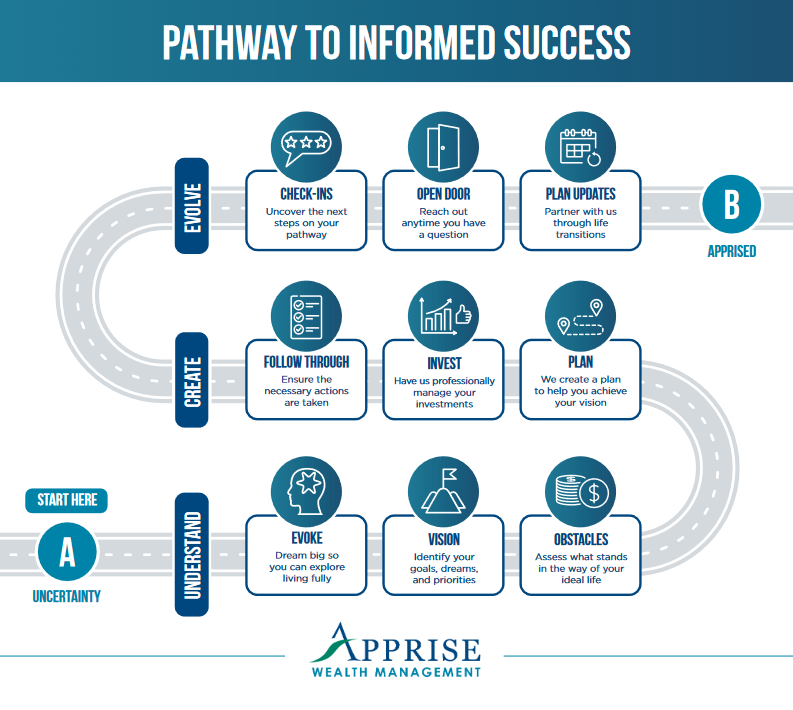
Pathway to Informed Success