



A common real estate mantra is “location, location, location.” While some are unaware and others don’t consider it, location matters to investors, too.

When it comes to investing, there are two types of diversification:
- Asset diversification
- Asset location
You diversify your assets by holding different asset types. This means holding stocks and bonds. It includes holding U.S.- and non-U.S.-based assets. It also involves holding assets with different market capitalization (sizes) and investment objectives.
To the extent possible, you also want to have a different type of diversification. You want to consider what kind of account you hold your assets in from a tax perspective. That’s what asset location for tax efficiency is all about.
From a tax perspective, you can place your investments in three different types of accounts. You can hold them in tax-deferred accounts (e.g., 401(k)s, 403(b)s, or Individual Retirement Accounts (IRAs)), taxable accounts, or tax-exempt accounts (e.g., Roth IRAs. Roth 401(k)s, or Health Savings Accounts). Paying attention to asset location for tax efficiency can improve your portfolio’s after-tax returns. For every tax dollar you save, you can save one dollar less – or spend one dollar more later.
Investors more commonly focus on asset allocation and/or diversification. Many studies show how diversifying your assets across different asset classes drives investment returns. Asset allocation also helps reduce risk. In short, we do not want to “put all our eggs in one basket.” If we diversify, we can increase the likelihood of achieving our long-term goals. We can also enhance our potential to realize long-term gains.
BY ACCOUNT VS. A HOLISTIC APPROACH
Many advisors manage portfolios and implement financial plans at the account level. This means they manage each account separately rather than taking a collective view. Account-level management typically puts a full allocation of investments into each account. As a result, clients with a 60/40 asset allocation model have the same investments in the same percentages in each of their accounts, i.e., taxable accounts, IRAs, Roth IRAs, etc.
This approach makes it much easier to manage a client’s assets. However, it can disadvantage clients who hold investments in taxable and tax-deferred accounts. Failing to locate specific investment types among account types can reduce the tax efficiency of your portfolio. For example, when buying or selling a new security, you may buy or sell it in each account. If choosing what assets to hold in a 401(k) account with limited options, you may have to select an inferior choice to maintain the desired diversification parameters. Failure to pay attention to asset location may also increase your overall tax bill.
At Apprise, asset location for tax efficiency matters. It is an important consideration for every client. For some clients, asset location is not possible initially. Why? They hold all their retirement assets in a workplace 401(k). If that’s the case, we look for opportunities to open a Roth IRA, complete Backdoor Roth conversions, start a taxable brokerage account, or fund a Health Savings Account.
Unfortunately, we cannot make a definitive ranking of the type of investments to place in tax-deferred accounts. Why? Several changeable factors can impact such ranking:
- Tax rates.– These can change due to the political environment and an investor’s income level.
- Investment Holding Periods.– These can be specific to the investor and the strategy she implements.
- Return Parameters.– These are constantly in flux as they are affected by the economy as well as market performance.
Factors Affecting Asset Location for Tax Efficiency
Consider the following factors when deciding where to locate an investment.
- Can you place the investment in a tax-deferred account?Unfortunately, you cannot own all investment types in tax-deferred accounts. For example, under the tax code, you cannot own collectibles in IRAs. There are some exceptions related to precious metals, including certain gold and silver coins issued after 1986, along with silver, platinum, and palladium bullion. The ability to own real estate in an IRA is also limited.
- Taxation of Interest. While there are some exceptions (e.g., municipal bond income), most interest is taxable as ordinary income.
- Taxation of Capital Gains.You realize a capital gain when you sell or exchange an investment for more than the purchase price. Short-term capital gains get taxed as ordinary income. They arise when you sell investments held for a year or less. Long-term capital gains result from the sale of an asset held for more than one year. The tax rate for long-term capital gains is lower than the investor’s ordinary income tax rate.
- Taxation of Capital Losses.You realize a capital loss when you sell or exchange an investment for less than its cost basis. In taxable accounts, capital losses offset any capital gains first. You combine short-term gains and losses, leaving you with a net gain or loss. Then you follow the same process for long-term gains and losses. If capital losses exceed gains, you can deduct up to $3,000 of such losses annually. You can carry unused capital losses forward until used. Generating a capital loss in a tax-deferred account provides no tax benefits.
- Taxation of Dividends.Qualified dividends are paid from corporate earnings and receive the same preferential tax rate as long-term capital gains. But not all dividends are qualified. For a dividend to be qualified, it must have been paid by a U.S. corporation or a qualified foreign corporation. You must also own the stock for more than 60 days during the 121-day period that begins 60 days before the stock’s ex-dividend date. Dividends from tax-exempt corporations or organizations that generally are not subject to income tax are non-qualified. Non-qualified dividends get taxed at the same rate as ordinary income. (See below for special rules related to dividends paid by Real Estate Investment Trusts – REITs.)
- Foreign Taxes Paid. If you own non-U.S.-based securities, you may pay withholding tax on any dividends you receive. If you hold the shares in a taxable account, you can claim either a credit (dollar-for-dollar reduction in taxes) or a deduction for the withholding tax when you file your tax return. Please note that only income taxes, which include withholding taxes, qualify for credit on your U.S. tax return.
- Dividends Paid by Real Estate Investment Trusts (REITs). REIT dividends are considered pass-through income to the shareholder. This allows them to qualify for the qualified business income or QBI deduction. This deduction was created as part of the Tax Cuts and Jobs Act of 2017. It went into effect in the 2018 tax year. The QBI deduction allows you to deduct the lesser of: 20% of your qualified business income (QBI), plus 20% of qualified real estate investment trust (REIT) dividends, and qualified publicly traded partnership (PTP) income, or 20% of your taxable income minus net capital gain. Please note that the QBI rules are scheduled to sunset at the end of 2025. We do not know if the QBI rules will continue to apply in 2026 and beyond.
- Tax-Deferred Accounts.Tax-deferred accounts allow a taxpayer to delay paying taxes on assets contributed to the account until some future date – typically when the assets are withdrawn. Examples of tax-deferred retirement savings accounts include 401(k), 457, and 403(b) plans for employees as well as Keogh plans and SIMPLE IRAs for self-employed individuals. These plans allow you to contribute a percentage of your pre-tax salary to one or more investment accounts. This provides tax-free growth. Regular or traditional IRAs are also tax-deferred accounts.
- Tax-Deferred Assets. Tax-deferred assets allow a taxpayer to defer at least some of the income the asset generates.
- S. Savings Bonds. Owners of U.S. savings bonds can wait to pay taxes until they cash in the bond, when the bond matures, or when they transfer the bond to another owner.
- Master Limited Partnerships (MLPs).If you own shares of a master limited partnership, you can take advantage of the tax deferral embedded within its structure. MLPs can use depreciation to offset distributed cash flows. This means the taxable amount they distribute to unitholders will be lower than any actual cash distribution. Untaxed distributions can also result in a reduction in your basis in the shares. (This means you reduce what you paid for the shares by the amount of this distribution. As a result, when you sell shares of an MLP at a gain, some of the gains will be taxed at the lower capital gains rate.
- Tax-Exempt Status.Tax-exempt refers to income earned or transactions that are free from taxation. Examples of tax-exempt retirement accounts include Roth 401(k), Roth 403(b), and Roth IRA accounts. You fund such accounts with after-tax dollars. These provide future benefits. Withdrawals taken following a five-year period after contributions to the account have been made, and generally, after the account owner is at least age 59 ½, are not subject to taxes.
- State and Local Taxes. Some securities are exempt from federal and/or state taxes.
- Municipal Bonds. Interest income from investing in municipal bonds is free from federal income taxes. In most cases, interest income investors receive from securities issued by municipalities within their state of residence is also exempt from state and local taxes. Interest income from bonds issued by U.S. territories and possessions is exempt from federal, state, and local income taxes in all 50 states. The same can apply to government agency bonds such as GNMAs.
- Interest Income from Treasury Bills and U.S. Savings Bonds. You pay federal income taxes on interest income earned from Treasury bills, notes, and bonds. But you do not pay state and local income taxes on such amounts. Similarly, you pay federal income tax on income from U.S. savings bonds. You do not pay taxes on this income at the state or local level.
Other Tax-Exempt Accounts:
- 529 College Savings Plans. The 529 savings plan is also a tax-exempt account. You contribute after-tax dollars to the account. However, you pay no taxes on portfolio earnings provided you use the funds for educational purposes. Many states also allow taxpayers to deduct contributions to such accounts.
- Health Savings Accounts (HSAs).You can make tax-deductible contributions to HSAs. You can withdraw amounts that reimburse qualified medical expenses tax-free as well. Assets held in such accounts can also generally grow tax-free.
Some Advantages of Asset Location for Tax Efficiency
When possible, hold tax-inefficient investments in retirement accounts, tax-efficient investments in taxable accounts, and high-return investments in Roth IRAs or HSAs. Why? Appreciating investments held in an IRA will get taxed at ordinary income rates upon withdrawal. This treatment will even apply to your heirs.
If held in a taxable account, appreciation in your assets does not get taxed unless and until you sell the asset. In that situation, capital gains tax rates, which are lower than ordinary income tax rates, apply. Therefore, holding investments with high appreciation potential in IRAs is akin to telling the government it is okay to potentially pay much more in taxes.
Another advantage: If you are a long-term buy-and-hold investor and do not need to sell appreciated assets held in taxable accounts during retirement, your heirs will benefit. Under current law, the basis in such assets gets stepped up to fair market value when you die. Your beneficiaries could potentially pay no tax at all when selling the asset.
Holding tax-inefficient investments, such as U.S. bonds, in a retirement account, effectively defers any taxes until you start drawing down the account. Although this will result in ordinary tax when earnings are realized, the income would have been subject to ordinary tax anyway. While you can hold municipal bonds in a taxable account, they typically provide less income. Also, fixed-income investments tend to produce lower long-term returns than equities, resulting in lower required minimum distributions and less potential for income inclusion when you pass assets on to your heirs.
Holding the highest return investments in a Roth IRA ensures the greatest tax efficiency from an account that may never be subject to tax. That means the account should only hold equities. While it can entail more risk, you should have a long time horizon for a Roth account. That makes it better suited to handle volatile investments with the potential to produce higher long-term returns.
Having investments with greater growth potential in a Roth account provides two primary benefits.
- You don’t pay taxes on your gains.
- Your heirs won’t pay taxes on withdrawals from Roth accounts either. (Note that heirs, other than your spouse, will generally only have 10 years to withdraw money from a Roth IRA.) (See this blog for additional information.)
There is one other factor to consider. If you sell investments held in retirement accounts at a loss, you will not realize such losses for tax purposes. Not every investment increases in value; some are bound to decline.
Health Savings Accounts (HSAs)
Those focused on asset location for tax efficiency who have an HSA that includes investable assets should view it similarly to a Roth IRA or a Roth 401(k). As long you use your HSA to reimburse you for qualified medical expenses, you won’t pay any taxes on HSA funds when you make withdrawals.
Examples Showing the Benefits of Asset Location for Tax Efficiency
Interest Income: Assume your target asset allocation is 70% equities and 30% fixed income. If you do not need current income from your portfolio, asset location for tax efficiency can prove beneficial. Hold as much of your fixed-income security allocation in your IRA as possible. Why? You won’t pay current taxes on the interest income they generate.
Fixed-income assets are less likely to provide meaningful growth. That leads to a second benefit. When you withdraw money from your account, your tax bill will be less. Remember that withdrawals from your IRA are treated as ordinary income. Ordinary tax rates exceed capital gain rates.
Please don’t interpret any of this as meaning we don’t want your assets to grow. We do. That’s always one of our objectives when we manage a client’s portfolio. Asset location for tax efficiency relates to deciding which assets you hold in each account type. If you have more than one account type, you want to think about which type of asset belongs in which type of account.
Foreign Taxes: You are a shareholder of a French corporation. You receive a $100 refund of the tax paid to France by the corporation on the earnings distributed to you as a dividend. The French government imposes a 15% withholding tax ($15) on your dividend income. You receive a check for $85. You report the $100 as dividend income. The $15 of withheld taxes represents a qualified foreign tax. You can claim the $15 of foreign taxes as a credit against the taxes owed on your dividend income. That means your tax bill will be lower.
You could deduct the foreign taxes instead, but that’s usually less favorable than a tax credit. Any foreign taxes you deduct must be treated as itemized deductions. You also must deduct all your foreign taxes. You cannot claim a foreign tax credit for some and deduct others.
But you can’t deduct foreign taxes you pay on investments held in a tax-deferred retirement account. The income in those accounts is not subject to current U.S. tax (at least not until you begin making withdrawals).
But don’t worry—you won’t lose the benefit of the foreign taxes you paid in those accounts. The foreign taxes reduce the income earned in that account. It’s like you take a deduction against the income, and when you withdraw the money, you are only taxed on the net amount. It’s like claiming an itemized deduction for your foreign taxes.
If you have a Roth IRA, the situation is a bit different. Withdrawals from Roth accounts are not taxed by the IRS, so the foreign taxes you paid provide no benefits. But don’t let the absence of a tax benefit deter you from holding foreign investments in your Roth account. In some cases, it could still make sense to have foreign assets in those accounts. There are many other factors to consider apart from taxes when making investment decisions. For example, portfolio diversification and the suitability of the asset for your portfolio.
Appreciated Assets: You bought 200 shares of XYZ Inc. for $10/share. Twenty years later the shares are worth $150 each. Pat yourself on the back for buying those shares. You turned a $2,000 investment into $30,000. Assume you are in the 15% tax bracket for capital gains. You file a joint tax return, and your income is $200,000 in retirement. Nice job. You did a great job of saving for retirement, too. Your filing status is Married Filing Jointly. Let’s look at the difference in tax cost when you sell the shares and withdraw the net proceeds. Note: This analysis excludes state income tax effects:
- Shares held in a taxable account:You have a capital gain of $28,000 ($30,000 – $2,000. With a 15% tax rate, you pay $4,200 ($28,000 x 15%) of federal income taxes. Your net proceeds: $25,800 ($30,000 – $4,200).
- Shares held in your IRA: For this purpose, your gain or loss doesn’t matter. You apply your 24% tax rate to the $30,000 of sales proceeds. You pay $7,200 in taxes ($30,000 x 24%). Your net proceeds: $22,800 ($30,000 – $7,200).
- Shares held in your Roth IRA or HSA: Your gain or loss doesn’t matter for this purpose either. You pay no taxes when you withdraw the sales proceeds. (Assume you have qualified medical expenses if withdrawing funds from your HSA.) Your net proceeds: $30,000 ($30,000 – $0).
Those tax savings matter. They become even more meaningful when you apply them across an entire portfolio.
Don’t Let the Tax Tail Wag the Dog
Limiting how much you pay in taxes makes sense as long as it helps you maximize after-tax returns. That’s the benefit asset location for tax efficiency can provide. However, remember not to make decisions solely based on tax implications. Plus, to implement such a strategy, portfolios must be managed at the household level and not on an account-by-account basis. This can add complexity. It can also make the returns in individual accounts uneven. Overall, utilizing such a strategy can allow you to benefit from lower current and future taxes.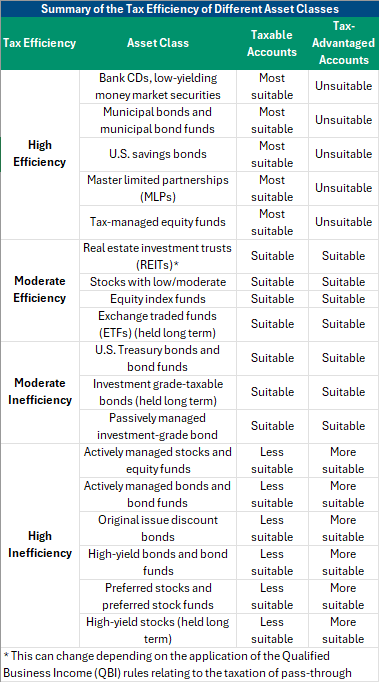

Asset Location for Tax Efficiency Summary: Tax Efficiency of Different Asset Classes
Tax-inefficient investments typically include those providing mostly current income. Unless you need the income currently, you should consider placing such investments with the greatest potential tax liability in your IRA or 401(k).
Investors should also be aware of the tax benefits associated with certain securities. For example, municipal bonds, U.S. government securities, and MLPs provide tax benefits that make them more appropriate for taxable accounts.
FAQs:
1. What is asset location—in plain English?
Asset location means deciding which accounts hold which investments so you keep more of your after-tax return. Rule of thumb: park tax-inefficient, ordinary-income assets (e.g., taxable bonds, many REIT funds) in tax-deferred accounts (401(k)/traditional IRA); keep tax-efficient/appreciating assets (broad stock index funds, munis when appropriate) in taxable; and put highest-growth assets in Roth/HSA, where growth can be tax-free.
Quick distinction: Asset allocation = what you own. Asset location = where you hold it.
2. What’s the rule of thumb for “what goes where”?
- Tax-deferred (IRA/401k): Tax-inefficient, income-heavy assets—taxable bonds, many REIT funds, high-turnover/high-distribution strategies.
- Taxable: Broad stock index funds/ETFs, long-term individual stocks, muni bonds (after-tax yield dependent), foreign stock funds if you want the foreign tax credit.
- Roth/HSA: Highest-expected-return assets (usually equities), allowing for tax-free compounding and withdrawals.
- Always adjust for your bracket, state taxes, account menus, and cash-flow needs.
3. How do I implement this at the household level (without making a mess)?
Set a household target mix, then assign assets to accounts. Rebalance inside IRAs/401(k)s, and Roths first to avoid realizing gains. In taxable, steer with new cash/dividends and tax-loss harvesting. Avoid wash sales by not harvesting losses in an asset you also buy within 31 days in another account. Account statements may look uneven; the household view is what matters.
4. Are there important exceptions or special cases?
- REITs: Dividends are mostly ordinary income (tax-deferred often best). In taxable accounts, you may get the QBI deduction on REIT dividends—run the math.
- MLPs: K-1s and potential unrelated business taxable income (UBTI) make holding them in IRAs tricky; it is often better to keep them in taxable accounts.
- Foreign funds/stocks: The foreign tax credit is only available in taxable accounts.
- Munis: They usually belong in taxable accounts; you lose the related tax break when you hold them inside IRAs.
- State taxes & plan menus can flip the usual answers.
5. What are common mistakes to avoid?
Cloning the same 60/40 allocation in every account; reaching for yield in taxable accounts; ignoring dividend tax drag; holding munis inside IRAs; overlooking the step-up/estate implications on appreciated taxable assets.
6. What if all my savings are currently in a 401(k)?
Build tax diversity over time: use Roth features (or backdoor Roth if eligible), start a taxable brokerage for surplus savings, and fund an HSA if you have a High Deductible Healthcare Plan (HDHP). As new buckets grow, migrate your assets toward a tax-savvy location map.
7. How significant is the benefit—worth the effort?
Location won’t fix a bad allocation, but over decades, it can add an after-tax return roughly akin to shaving ~0.20–0.40% per year in fees—sometimes more in higher brackets. Small, repeatable tax wins compound.
8. When should I bend or break the rules?
When simplicity, liquidity, planning menus, spending needs, or risk control take precedence over If you’ll spend from taxable soon, keeping some bonds there can be wise. If a 401(k) menu is limited, use its best cores there and place the rest elsewhere. Tax efficiency is a tool—not a straitjacket.
Summary
Considering which account should hold which investments matters. It can help investors with both taxable and tax-advantaged accounts reduce their taxes. It often helps to consult with a professional before making asset location decisions. Suggestions in this blog may not apply to everyone as its primary purpose is to provide general guidance. We hope it helps you better understand the benefits of diversifying your assets across different account types to maximize after-tax returns. Asset location for tax efficiency can help lower your lifetime tax bill.
Do you need help applying asset location for tax efficiency to your investments? I would be happy to schedule a call to answer your questions. Click my CALENDAR LINK to schedule a call. I enjoy discussing topics like this.
Our practice continues to benefit from referrals from our clients and friends. Thank you for your trust and confidence.
We hope you find the above information valuable. If you would like to talk to us about financial topics including your life plan, your investments, creating a financial plan, saving for college, or saving for retirement, please complete our contact form. We will be in touch. You can also schedule a call or a virtual meeting via Zoom.
Please note. We post information about articles we think can help you make better money-related decisions on LinkedIn and Facebook..


For firm disclosures, see here: https://apprisewealth.com/disclosures/


Phil Weiss founded Apprise Wealth Management, where he works with women facing new beginnings. He started his financial services career in 1987 working as a tax professional for Deloitte & Touche. For the past 25 years, he has worked extensively in the areas of personal finance and investment management. Phil is a CFA charterholder, a CPA, and an RLP®.