



Most of us learn to think about money as protection. Earn enough to pay the bills. Build an emergency fund. Save for retirement. Avoid taking on too much debt. Prepare for what can go wrong.
Those things matter because financial security creates options.
But if you spend decades building security, another question eventually deserves your attention:
What is your money for?
That question sits underneath the idea of financial freedom.
I think of financial freedom as a continuum, not a finish line. It does not require a particular portfolio value or the ability to stop working forever. It means having enough financial strength and flexibility to make more choices based on what matters to you rather than what your next paycheck requires.
People do not start with the same resources or constraints. Even a little more financial margin can widen your choices.
Sometimes you create that freedom by spending money. Sometimes you create it by not spending. Sometimes you create it by keeping your obligations manageable.
And sometimes, after years of saving, you create it by giving yourself permission to use what you have built.
Key Points
|
This is the third article in a three-part series about creating more room for what matters. In Part 1, I explored why your next chapter may be more like a dimmer switch than a light switch. In Part 2, I looked at subtraction and what you may want to stop, reduce, or delegate. Here, we turn to the role money can play in creating greater freedom.
Security Gives Financial Freedom a Foundation
When I ask clients, “What is most important about money to you?” I most often hear two answers: security and freedom. Dig a little deeper, and those answers often lead to questions like:
- Will I be okay?
- Can I afford to retire?
- Will I have enough if something unexpected happens?
- Can I support myself after a divorce or widowhood?
- Can I help my children without jeopardizing my own future?
Those questions deserve serious answers.
Financial freedom does not mean ignoring the basics. High-interest debt can restrict choices. Too little cash can make an unexpected expense feel like a crisis. Saving too little for an important goal can leave you dependent on income longer than you want.
No universal formula tells you when you can spend more freely. But building an emergency reserve, avoiding high-interest debt, and saving appropriately for your goals can create the foundation that lets you make choices with more confidence.
For me, knowing that I am meeting my savings goals makes it easier to spend on what I value. Security does not eliminate uncertainty. It gives you more room to respond.
Financial Freedom Is More Than Financial Independence
People often use “financial independence” to describe the point when work becomes optional.
That matters. But I think financial freedom is broader than that.
You can have substantial assets and still feel trapped. A high-cost lifestyle, a large house, or a growing list of recurring expenses can require more income and quietly narrow your choices.
On the other hand, money can make it easier to say no.
I have become more willing to tell a prospect I am not the right advisor when the fit is not there. I have ended a client relationship that had become a poor fit. I have turned down consulting and one-off work that did not interest me.
I could have accepted the money. I valued the freedom more.
Money can fund your no.
That may mean saying no to work you don’t want, a purchase that would create an obligation you don’t want, or a situation you no longer need to tolerate solely because of the financial consequences.
Money Can Protect the Rest of Your TEAM
At Apprise, I often talk about your TEAM of Capital:
Time. Energy. Attention. Money.
Money is different from the other three because you can sometimes exchange it to protect them.
Money can free Time, preserve Energy, and reduce demands on Attention.
That does not mean you should outsource every task. It means the price tag is only part of the cost.
My wife and I resisted hiring someone to help clean our house for a while. I focused on the cost. Eventually, I realized I was looking at only one part of TEAM. Paying someone meant we spent less Time and Energy cleaning and had one less recurring task demanding our Attention.
I have made similar choices at Apprise.
Hiring my son to take on work that does not require me has freed capacity for work where I contribute more. Hiring a compliance consultant costs money, but it has reduced the Time, Energy, and Attention I devote to compliance documentation and processes.
Looking ahead, I expect to spend more on people and infrastructure so the firm does not depend on me to handle everything.
That will cost money. It should also give me more flexibility when I travel and more ability to focus on the work I most want to keep doing.
That is one way to think about the tradeoff: use some of your Money to create more capacity in the rest of your TEAM.
Sometimes Not Spending Creates More Freedom
There is another side to this. While spending money can create freedom, it can also reduce it.
My wife and I have discussed owning a second home, especially after spending time with friends who had a beach house.
We enjoyed visiting. We also realized we did not want one.
A second home might have given us a familiar place to return to. It also would have created another property to maintain, another set of expenses, and perhaps even a subtle obligation to keep going to the same place because we owned it.
Instead, our family has traveled to different places and shared different experiences. When we leave a hotel or rental, we leave the maintenance behind, too.
I think similarly about cars. I prefer to buy them, maintain them, and keep them for a long time. Having no car payment preserves flexibility.
The point is not that second homes or new cars are bad choices. They may bring enormous value to someone else. The point is that every purchase has two sides:
What does this give me?
And:
What does this require from me after I buy it?
Sometimes the best financial decision is not the one that gives you more. It is the one that leaves you with fewer obligations.
From Saving to Using: What Does Enough Make Possible?
Some of the best savers I meet struggle the most with spending their money.
That makes sense. You build financial security by working, saving, delaying gratification, and learning to be careful. Repeat those behaviors for decades, and using what you have built can feel surprisingly uncomfortable.
Fear of running out is powerful. I have heard people joke that they do not want to end up eating cat or dog food late in life. The joke points to something real.
Our earliest money memories can stay with us for decades. Someone who grew up with financial insecurity may find it hard to believe the numbers, even when the analysis suggests she has room to spend more.
This is where “enough” becomes important.
Enough is different for everyone. It depends on your needs, goals, resources, risks, family, and the life you want to support. But if the goalpost keeps moving every time you reach it, the issue may no longer be the number. You may never have defined how much is enough, or what you want that money to support.
At some point, accumulating another dollar may add less to your financial freedom than thoughtfully using a dollar you already have. That does not mean you stop planning. It means the plan begins serving a different question.
Instead of asking only:
How much more do I need?
You can also ask:
What can the resources I already have responsibly make possible?
A financial plan can help you evaluate:
- Can I afford this choice?
- What does it cost me somewhere else?
- What risks does it create?
- What does it make possible?
The financial analysis matters because “money is for living” is not permission to spend without limits. It is a reason to understand the limits well enough that fear does not become the only thing driving the decision.
Waiting Has a Cost, Too
Financial planning does not always measure another risk neatly: waiting.
I have written before about putting a health line next to your bucket list. Some things become harder as you get older. Some may eventually become impossible.
That is one reason active travel matters to me. I want to see places, hike, explore, and share experiences with my family while I have the health and energy to do those things.
I exercise most mornings partly because I want to remain active with my wife and children years from now.
Money cannot guarantee that future.
But financial freedom can give you more ability to act while those windows are open.
There is a balance here. You do not want to jeopardize tomorrow because you are impatient today. But you also do not want to protect tomorrow so aggressively that you never use today.
Someday is not a financial plan.
Freedom Is Not the Absence of Responsibility
The goal is not to outsource your life. There are plenty of things I could pay someone else to do, but I prefer to keep doing them myself.
I enjoy cooking for my family, and I still do much of our grocery shopping because eating well matters to me.
I manage my own finances because I enjoy financial planning, tax planning, and investing. If I hired an advisor, the main value I would seek would be another perspective, not freedom from the subject.
I also enjoy riding my bike. I do not plan to switch to an e-bike until my body tells me I need the help. I enjoy powering the bike myself, being outside, and the effort the ride requires.
Freedom is not the absence of responsibility. It is having greater ability to choose which responsibilities deserve your resources.
Transitions Change What Financial Freedom Looks Like
Major transitions can change what freedom looks like. After divorce, it may mean enough margin to avoid making every decision around immediate cash flow.
After widowhood, it may mean enough liquidity and support to make decisions slowly. During an empty nest, it may mean reconsidering the house, spending, work, and routines built around raising children.
As you approach retirement, it may mean discovering you can work less before you stop completely. As life changes, so does money’s role.
The question remains:
What do I want my money to make possible now?
A Four-Question Freedom Test
Before you make a financial choice because you believe it will give you more freedom, ask four questions.

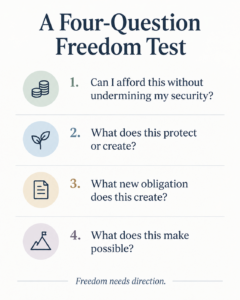
1. Can I afford this without undermining my security?
Look at cash flow, savings, debt, taxes, liquidity, and the other goals the money still needs to support. Freedom built on new financial anxiety is not really freedom.
2. What does this protect or create?
Does the choice protect Time, preserve Energy, reduce demands on Attention, or create financial flexibility? If you cannot name the benefit, the choice may not be creating much freedom.
3. What new obligation does this create?
A choice can solve one problem and create another. Consider any maintenance, recurring expenses, commitments, or loss of flexibility it creates, and how hard it would be to reverse.
4. What does this make possible?
This is the most important question. Maybe it creates more time with people you love, allows you to travel or help family, lets you work differently, reduces worry, or makes something meaningful possible before the window closes.
Freedom needs direction.
I Have Chosen Freedom Over Income Before
Starting Apprise was one of the clearest examples in my own life. I earned considerably less when I started the firm than I had before. For a period, I continued consulting and doing other work while trying to build the firm. Trying to do both kept me from giving Apprise the focus it needed. I stopped the other work and committed fully.
Financially, that meant accepting little income from Apprise in the short term. Over time, it gave me something I value more: control over the kind of firm I wanted to build, whom I wanted to serve, how I wanted to serve them, and how I wanted to work.
Increasingly, it also gives me more room for family, travel, health, writing, mentoring, and the parts of this work that matter most.
I am making another version of that choice now. Hiring people and building infrastructure will require me to accept lower short-term profits, but I value the flexibility and focus those investments can create. That is not freedom from work. It is more freedom to choose the work I want to keep doing.
What Is Your Money For?
I keep coming back to that question.
The question also connects closely to Even More Than Money: Five Ways to Design Your Financial Life, which includes a chapter I wrote. That chapter opens the book’s “Living” section and asks a related question: What kind of life do I want to live?
The book organizes that larger conversation around five ideas: Living, Changing, Dreaming, Giving, and Enduring.
I like those ideas because they remind us that money has more than one job. Its purpose can change as your life changes. Security matters. Freedom matters, too. But freedom by itself is not the destination.
The deeper question is what you want that freedom to support. That could mean traveling, helping your family, working differently, giving more, protecting your time, taking a risk, saying no, or simply worrying a little less.
Your answer may be different from mine, and both may look different five years from now. The important thing is to have an answer, because if you never decide what your money is for, “more” can easily become the default.
More savings.
More work.
More caution.
More waiting.
At some point, another question deserves equal attention:
What could your money make possible that you’re postponing?
If this question resonates, I have a limited number of complimentary copies of Even More Than Money available. You can request a copy here.
What Could Your Money Make Possible?
If you have spent years building financial security, the next question may not be how to accumulate more. It may be what you want your money to do for you now.
Financial planning can help you understand what choices your resources can support. Life planning can help you clarify which choices deserve those resources.
At Apprise, we help clients align their Time, Energy, Attention, and Money with the lives they want to build.
Schedule a call to talk about what you want your money to make possible.
Related Reading
- Your Next Chapter May Be a Dimmer Switch, Not a Light Switch
- A Better Life May Require Subtraction
- You May Have Enough Money. But Do You Have Enough Life?
This post is educational information, not individualized investment, tax, or legal advice.
Our practice continues to grow through introductions from our clients and friends. Thank you for your trust.
If you would like to discuss financial topics, including navigating new beginnings, managing your investments, creating a life plan, or saving for retirement, please schedule a call or a Zoom virtual meeting. We will be in touch.
Follow us:
Facebook | LinkedIn | Instagram | YouTube | Substack
Please note: We post information about articles that can help you make better money-related decisions on Facebook, LinkedIn, Instagram, and YouTube.


For firm disclosures, see here: https://apprisewealth.com/disclosures/


Phil Weiss founded Apprise Wealth Management, where he works with women facing new beginnings. He started his financial services career in 1987 working as a tax professional for Deloitte & Touche. For the past 25 years, he has worked extensively in the areas of personal finance and investment management. Phil is a CFA charterholder, a CPA, and an RLP®.