



We often talk about life’s biggest transitions as if someone installed a light switch.
You’re working. Then you’re retired.
You live in the house where you raised your family. Then you sell it and move.
You have a demanding career. Then you leave.
One life ends. Another begins.
Sometimes life really does work that way. I’ve had a few light-switch moments of my own.
But retirement and many other major life changes don’t always have to happen all at once.
Sometimes you can turn the dial.
You can work a little less before you stop working. You can give up some responsibilities while keeping the parts of your work you still love. You can spend some time in a place before deciding whether you want to move there. You can pay someone else to handle something that consumes your time, energy, or attention. You can try something new before you know whether you want it to become a bigger part of your life.
That’s one reason I like the image of a dimmer switch.
The point isn’t to avoid difficult decisions or put them off indefinitely. It’s to recognize that when life changes, the choice in front of you may not be as binary as it first appears.
Sometimes creating a little space between where you are and where you’re going helps you discover where you really want to go.
Key Points
|
This is the first in a three-part series about using your financial resources to create more room for what matters. Next, we’ll explore what you may want to stop doing, followed by how you can use money to create more freedom for what matters most.
Some Changes Really Are Cliffs
I recently read Jim Collins’ What to Make of a Life. One idea that stayed with me was his description of “cliffs.”
A cliff is a significant break in the path your life has been following. A career ends. A relationship ends. Your health changes. Someone you love dies. An identity that helped define you no longer fits. Some cliffs are choices. Others arrive without our permission.
What comes afterward isn’t necessarily obvious.
Collins calls that period the “fog.” Even highly accomplished people can struggle to figure out what comes next after a major life change. Life doesn’t proceed neatly from one clearly defined chapter to another.
That rang true for me because my own career has included several twists and turns.
I started as a tax professional. I became a writer and editor, then an equity analyst, and later a portfolio manager for a financial advisor. I left that role and started my own financial planning firm.
Some of those transitions happened gradually.
One didn’t.
When I left my last job working for another advisor, I didn’t know exactly what I would do next. Eventually, I decided to start my own firm.
That was a light-switch decision.
Looking back, starting Apprise was the best career decision I’ve ever made. It changed the work I could do for clients. It gave me more control over the kind of firm I wanted to build. It was better for me and, I believe, better for my family.
But that doesn’t mean the path was easy.
When I first started Apprise, I didn’t immediately commit all of my working time to building the firm. I worked as a freelance financial writer while trying to build a business alongside it.
Eventually, I realized that wasn’t going to work.
If I wanted to find out whether I could build the firm I envisioned, I had to go all in and make building Apprise my full-time focus.
Even then, success didn’t happen immediately. At the end of my second year, things were still difficult. I remember my wife telling me, in effect, that this was the year. I had to turn it into a sustainable business, or I would have to go back to working for somebody else.
By the end of that third year, I knew I had built something that could last.
The lesson isn’t that going all in guarantees success. It doesn’t. It’s that I reached a point where I couldn’t find out whether Apprise could become what I wanted it to be without committing fully.
Sometimes keeping your options open helps. Sometimes it keeps you from committing fully to the path you’ve already chosen. Knowing when flexibility has stopped helping matters. One way to think about it is this: If a reversible experiment can help you learn something important, consider turning the dial. If keeping your options open is preventing you from pursuing a path you’ve already chosen, it may be time to flip the switch.
But a Dimmer Can Create Room for What Matters
Other important choices in my life have looked very different.
When my four children were younger, I knew I had responsibilities at work. But I also knew I wanted to be there for them.
So I varied my hours.
I coached their teams across several sports from kindergarten through high school. Practices, games, car rides, and all the ordinary things that come with being an involved parent took time that I could have devoted to work.
Could I have advanced faster professionally if I had made different choices?
Maybe.
But I wouldn’t trade that time for anything.
My children are older now. I’m proud of the relationships I have with them and how close our family is. Our four children still want to spend time with us.
I wouldn’t trade that for any professional accomplishment.
I made a similar choice when my mother was sick.
I started taking some Fridays off so I could spend more time with her.
Was that the optimal decision for my career? No. I advanced quickly, getting promoted to manager in only four years. After that, my public accounting career stalled. I ultimately left for a job in private industry.
Despite that, it was absolutely the right decision for my life. With the benefit of hindsight, I can see how that decision contributed to the career changes that eventually brought me to where I am today.
My mother died when she was 53. Those Fridays weren’t something I could defer and recover later.
I couldn’t put them into an account and use them when work was less busy.
That is one of the differences between time and money that we too often overlook.
You can sometimes earn back money. You can never earn back time. You cannot recover another Friday with someone who is no longer here.
In both cases, I didn’t turn work off. I turned it down enough to make room for something that mattered more.
A Retirement Transition Doesn’t Have to Be an On-Off Switch
I think about these choices when someone asks one of the most common questions in financial planning:
Can I afford to retire?
It’s an essential question. But it isn’t the only question that matters.
For many people, work represents much more than a paycheck. It creates structure. It provides social interaction. It offers intellectual stimulation, and sometimes a sense of identity. And, fairly or unfairly, it can become wrapped up in how we answer a very basic question:
Who am I?
If you’ve spent 30 or 40 years answering that question partly through your career, the move from working on Friday to being “retired” on Monday can represent a much bigger change than a financial projection captures.
You can have enough money and still have no idea what you’re retiring into.
For many people, a retirement transition should include a question that comes before ‘Can I afford to retire?’
What would allow me to live a more fulfilled life?
Maybe the answer is retirement.
But maybe it isn’t. Or maybe it isn’t yet.
- Could you work less or reduce your responsibilities?
- Could you consult, take a sabbatical, or spend longer periods away from work?
- Could you try something entirely different part-time?
- Could you make room for family, volunteering, learning, or something you stopped doing years ago?
In other words, what happens if you turn the dial before you flip the switch?
Point Reallocation: Collins’ Version of a Dimmer Switch
One idea in Collins’ book is particularly relevant here.
When people in his research could see a coming cliff, some began gradually redirecting their energy before they reached it. Collins calls this “point reallocation.”
Imagine you have 100 points representing your attention and effort.
At first, perhaps all 100 go toward one thing. Over time, you begin shifting some of those points elsewhere.
Collins uses former NFL star Alan Page as an example. Football initially consumed virtually all of his professional attention. Then he began taking law classes. Gradually, more of his effort shifted toward law until he eventually left football and built an entirely different career, ultimately serving on the Minnesota Supreme Court.
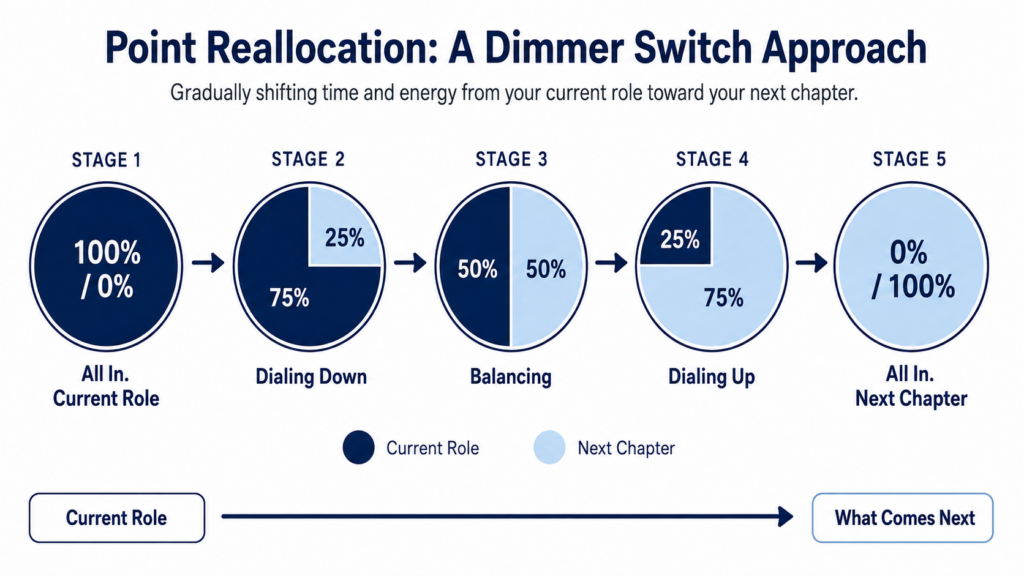
That’s a dimmer switch.
And it raises an important possibility for anyone approaching a retirement transition.
If you know your career will eventually end or change, why wait until the day after your retirement party to start discovering what else might engage you?
You can begin shifting some of those 100 points today.
Not because retirement requires you to remain “productive.” I don’t believe our worth depends on how much we accomplish.
But many of us still want something that makes us want to get up in the morning.
Something that engages us.
Something that connects us to other people.
Something that allows us to contribute, learn, create, care, explore, or simply experience more of a life that feels like ours.
Financial Flexibility Can Create Room to Experiment
This is where financial planning for a retirement transition becomes much more interesting than simply determining whether a portfolio can support a particular withdrawal rate.
Financial resources can create options.
- They can give you the flexibility to work less or say no.
- They can help you hire someone to handle work that takes time and energy away from what matters more.
- They can fund a sabbatical, travel, or another experience you want to pursue while you can.
- They can give you time and financial breathing room to figure out what comes next.
Of course, not every job or financial situation offers all of these choices. Working less can affect cash flow, employer benefits, retirement contributions, health coverage, and taxes. The dimmer-switch approach still has to work financially.
I’ve seen what this can look like in practice.
I wrote about one client in my chapter in Even More Than Money. She had spent much of her life focused on building a bigger pile of money without stopping to ask how much she needed or what she wanted the money to make possible.
Eventually, she left a demanding career that consumed a tremendous amount of her time, energy, and attention. Later, she took a part-time job working at Chicago Cubs games. The job wasn’t about maximizing income. It gave her something she enjoyed and created room for other priorities, including family responsibilities.
Her circumstances were unique, and her choices aren’t a prescription for anyone else. What matters is the broader question her experience illustrates: What is your money supposed to make possible?
You Don’t Need Certainty Before You Start
One thing that can keep us from turning the dial is the desire for certainty.
We want to know exactly how much we’ll spend, how markets will perform, how long we’ll live, what we’ll enjoy in retirement, whether moving will make us happier, and what our lives will look like five or ten years from now.
We’re not going to know.
When I worked as an analyst, reporters would sometimes ask me for forecasts of future oil prices.
I would give them a number.
But I would tell them there was one number I felt pretty confident oil prices wouldn’t be: the number I had just given them. Financial planning faces a similar problem: the future won’t match our assumptions exactly.
A plan is a forecast. We build it using the best information we have. We make assumptions. We model possibilities. We stress-test those assumptions.
But we cannot predict the future.
Some of those assumptions will be wrong.
Life will change.
And sometimes the information you need doesn’t exist yet because you haven’t lived the experience.
You don’t know exactly what retirement will feel like because you haven’t retired.
You don’t know whether you’ll like living somewhere else because you haven’t lived there.
You don’t know whether the thing you’ve imagined doing for years will still appeal to you once you have the time to do it.
The value of a financial plan isn’t that it predicts the future perfectly. It’s that it gives you a framework for evaluating tradeoffs and adjusting when reality turns out differently than expected. That’s why flexibility belongs in the plan.
Keep Your Eyes Open to What Else Is Possible
I’ve talked to my children over the years about not going through life with blinders on.
If you only focus on the path you think you’re supposed to follow, you can miss possibilities just outside your field of vision.
My own career wasn’t a straight line. I didn’t begin as a tax professional knowing I would eventually own a financial planning firm. Some opportunities became visible only because I remained open to what came next.
The same can apply as you approach a retirement transition. Instead of assuming retirement must look one particular way, remain open to alternatives. You may discover an option you couldn’t see while looking only at the traditional path.
When Waiting Has a Cost, Too
None of this means every decision should happen slowly.
That’s where the dimmer-switch metaphor has limits.
Sometimes you need to make the decision.
My experience building Apprise taught me that. Keeping one foot elsewhere was useful for a while. Eventually, it became an obstacle.
At some point I had to commit.
Waiting can also reduce your options.
Consider someone who loses a spouse or goes through a divorce and decides, almost by default, to remain in the family home.
I generally don’t think someone experiencing a major transition needs to rush into every big decision. Grief, stress, and uncertainty aren’t ideal conditions for making irreversible choices.
But “don’t rush” shouldn’t become “never decide.” The point isn’t that you should sell quickly. It’s that ‘stay for now’ shouldn’t quietly become ‘stay forever’ without revisiting the decision.
The home may eventually prove too expensive, too large, too difficult to maintain, or simply wrong for the life the person wants to build next.
External circumstances can change, too. Interest rates, housing prices, taxes, health, family needs, and other factors can make tomorrow’s choices different from today’s.
There is a balance.
Give yourself enough time to understand what you want. Preserve flexibility where it helps. Experiment when you can.
But recognize when preserving every option has started preventing you from choosing.
What Does Your Next Chapter Need More Of?
Today, I can see another dimmer switch in my own future.
I don’t envision working at full speed until some predetermined retirement date and then disappearing from Apprise.
There are parts of my work I want to do less of over time.
I want to keep building a firm that doesn’t require me to do everything.
But there are other parts of the work I hope to keep doing for a long time.
I enjoy helping clients think about the lives they want to live. I enjoy the problem-solving that comes with financial and tax planning. I enjoy writing. I enjoy mentoring and thinking about how to improve the firm, including the way it works with clients.
I don’t necessarily want to turn those things off.
I want the flexibility to turn some responsibilities down so I can devote more of my Time, Energy, Attention, and Money, which together make up what I call your TEAM of Capital, to the things that matter most.
That’s what I want for clients, too.
Not necessarily retirement.
Not necessarily more money.
Not even more freedom for its own sake.
I want them to use the resources they’ve accumulated to build lives that feel more like the lives they want to live.
Frequently Asked Questions
1. What is a retirement transition?
A retirement transition is the shift from your working life into what comes next. It can happen all at once or gradually as you reduce work, change responsibilities, or begin exploring other priorities.
2. Should I retire all at once or gradually?
There is no single right approach. Your finances, health, work, family responsibilities, identity, and what you want your next chapter to include should help determine whether a gradual transition or a clean break makes more sense.
3. How can financial planning help with a retirement transition?
Financial planning can help you understand what your resources make possible and evaluate the tradeoffs involved. The goal is not only to determine whether you can retire, but to help your money support the life you want to build.
Maybe the Better Question Is What You Can Turn Down
If you’re approaching a retirement transition or another major transition, you may feel pressure to figure out the destination.
Where will I live? When will I retire? What will I do? How much will I spend? What does the next chapter look like?
Those questions matter.
But you may not have to answer all of them today.
Instead, start with something smaller:
What could you turn down in your life before deciding whether you need to turn it off?
Maybe it’s work.
Maybe it’s responsibility.
Maybe it’s the amount of time you spend maintaining a house.
Maybe it’s something you keep doing only because you’ve always done it.
Maybe it’s an obligation you could pay someone else to handle.
Then ask what you want to make time for.
- Time with people you love?
- Health?
- Travel?
- Learning?
- Service?
- Creativity?
- Rest?
Something you haven’t discovered yet?
Then ask one more question:
What would need to be true financially for me to test that change?
A financial plan can help you understand what is possible. But the spreadsheet can’t tell you what deserves more of your life. That’s the deeper work.
Your next chapter doesn’t have to begin with one dramatic leap from Point A to Point B.
Sometimes the best path curves a little.
Sometimes you explore.
Sometimes you redirect a few of those 100 points and see what happens.
Sometimes you turn the dial.
And sometimes, after you’ve learned enough about where you want to go, you finally flip the switch.
What Could Your Next Chapter Look Like?
If you’re approaching retirement or another major life transition and aren’t sure what you want the next chapter to look like, your financial plan can help you understand the choices your resources make possible.
At Apprise, we strive to help clients align their Time, Energy, Attention, and Money with the life they want to build.
Schedule a call to talk about what you want your next chapter to make possible.
Want to read the rest of this series? Subscribe to receive the next article when it’s published.
Related Reading
- Preparing for Retirement: When Does Preparing Become Living?
- You May Have Enough Money. But Do You Have Enough Life?
- Discovering Fulfillment: Find Purpose and Meaning in Retirement.
- Financial Planning After a Major Life Change: Before You Ask, “Do I Have Enough?” Ask This Instead.
Interested in Even More Than Money?
I have a limited number of complimentary copies available for readers who may find its message especially relevant. Request a copy here.
This post is educational information, not individualized investment, tax, or legal advice.
Our practice continues to grow through introductions from our clients and friends. Thank you for your trust.
If you would like to discuss financial topics, including navigating new beginnings, managing your investments, creating a life plan, or saving for retirement, please schedule a call or a Zoom virtual meeting. We will be in touch.
Follow us:
Facebook | LinkedIn | Instagram | YouTube | Substack
Please note: We post information about articles that can help you make better money-related decisions on Facebook, LinkedIn, Instagram, and YouTube. You can subscribe to have articles delivered to you via Substack.


For firm disclosures, see here: https://apprisewealth.com/disclosures/