
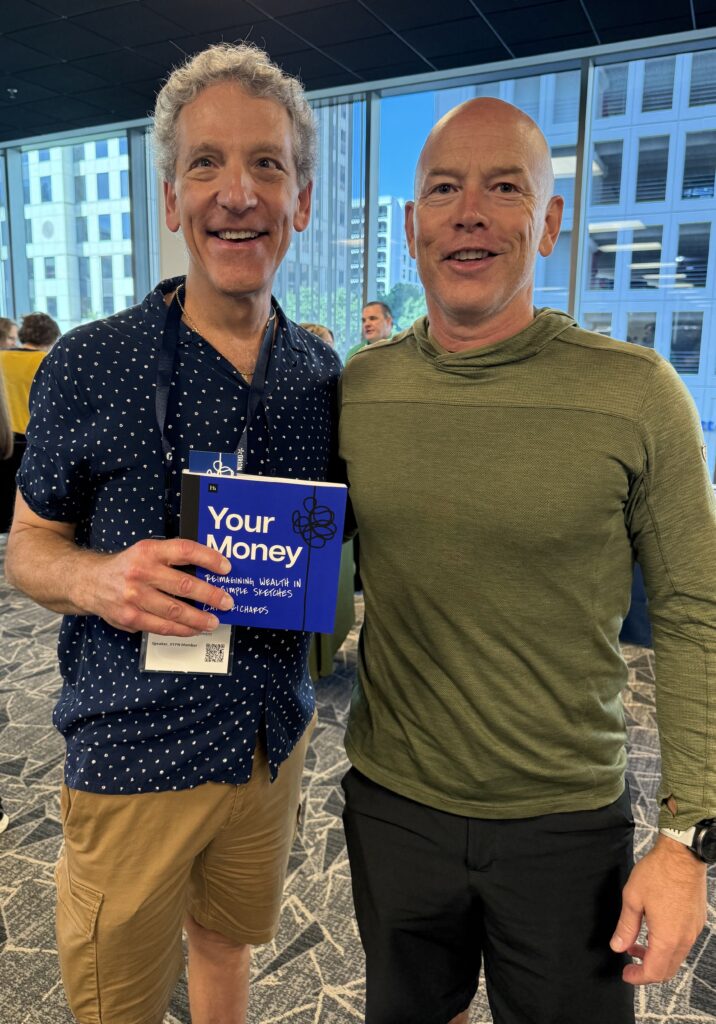
Watch the conversation: Real Financial Planning with Carl Richards here.
Prefer to read? The edited transcript appears below.
| About this 5-part series: I recently sat down with Carl Richards—author of Your Money: Reimagining Wealth in 101 Simple Sketches—for a practical, human conversation about aligning money with life, especially if you’re starting fresh after a big change. Across five short episodes, we cover: Real Financial Planning, TEAM (Time, Energy, Attention, Money), A One-Page Plan, Goals Are Guesses, and Tax Planning, Not Reporting. Each part includes a quick watch, an edited transcript, and one small step you can take this week. Want the next episode by email? Subscribe: https://apprisewealth.com/blog-sign-up/ |
What we cover in Episode 1 (Real Financial Planning)
Starting fresh after a significant life change can make money decisions feel noisy and urgent. In this opening conversation, Carl Richards and I define real financial planning—the overlap of your money and your life. We discuss staying in the room for the sometimes-clumsy conversations, why a plan is a living process (not a binder), and how alignment beats perfection when facts and feelings change.
| One Small Step (this week)
Pick one conversation you’ve been avoiding about money. Schedule 15 minutes with the person involved. Bring one question: |
Phil Weiss
Thank you for joining me today, Carl. I’m really looking forward to this conversation.
Carl Richards
Yeah, super excited to have it, Phil. Thank you.
Phil Weiss
Before we start, I just want to say that I love the idea of doing things to help us have better financial conversations. I think I told you in the past, I have played some episodes of your podcast, 50 Fires, when I’m in the car with my wife, and it’s really made for some good conversations. And I think that this book can do the same thing.
Carl Richards
Yes, I’ve sort of settled into the idea that that’s what my work is now about. It’s not about sketches, it’s not about books, it’s not about podcasts, it’s about conversations, right? And all of those sort of serve to help us have more of them in the world.
Phil Weiss
Yes, and we just don’t have enough. And so I think it’s really great.
Carl Richards
It’s true. It’s true.
Phil Weiss
And, it’s a really great process when you have those conversations. You learn so much.
Carl Richards
Yeah, and it’s often hard and challenging. So, we got to kind of stick with it. Give ourselves permission to be clumsy. Don’t tap out. I almost tuned out of a conversation we were having as a family about money last week. And it was the hardest thing I could do to stay in the conversation and not be offended, and not feel guilty, or not be defensive. I’m actually really proud of myself that I was able to stay in it and not tap out because they’re hard, but it’s the only way. I think a really good relationship with money happens in conversation. Right. So we need to have them.
Phil Weiss
Yeah, I know I have had them. I’m A registered life planner, and I have my life plan. There is an element in my life plan to create a scholarship for women who go back to school later in life. And every year in my house, at the end of the year, in December, we have this conversation about who we are going to make donations to this year that we haven’t donated to yet. And at the end of last year, this happened for the second time; my wife never mentioned the scholarship. And it was bothering me, and it kept bothering me. And then we were away together, in February, and it was my birthday. And I said to myself, this is the time I’m going to bring this up. And I brought it up, and she hadn’t realized that it hadn’t connected. And then, when we had the conversation, it’s okay now. And she gets it. But, you know, we sometimes just sit with those thoughts inside our heads and never do anything about them.
Carl Richards
Yeah, I think that’s particularly interesting around money, just because, at its core, it is just zeros and ones stored in a cloud. But what we tend to do and what you’re pointing out is that we build up these big stories around things. And in the absence of information, we will certainly create a narrative. And money is nothing more than zeros and ones with a giant pile of stories on top of them. And I think we, it turns out, your wife may just not have thought about it. Like it slipped her mind, and it was no less important. I know I can tell these stories about how they just don’t care. I can’t believe they don’t see how hard I work and how important this is to me. And in the absence of conversation, we’ll continue to believe that story. And so interesting once we bring it up. Sometimes we may find out a difficult truth, but often we find out, you know, especially if we bring it up in the right way, somebody says, ‘I’m so sorry, I didn’t realize that.’ If we can bring it up in the right way, there’s often immediate empathy. If we can create empathy, then suddenly everything in the room changes. So, being defensive, we’re saying things like, ‘Oh, how can I be helpful?’ So yes, I love that.
Phil Weiss
I want to turn to some of the sketches and chapters in your book that I really related to and talk a little bit more about them. The first one is just the idea of real financial planning. And I’d like you to talk about that, and then I’ll ask you a couple of questions.
Carl Richards
Sure. Yeah, there’s, so for your viewers and listeners, there’s this, I think of it as a Venn diagram. It’s two circles with a little bit of an overlap. And one circle is labeled your money. And the other circle is labeled your life. And the overlap is real financial planning. And sometimes, there’s a phrase, your money or your life. And sometimes it’s seen as a choice. In fact, there’s a great book, I think one of the best books ever written about personal finance. by that title, Your Money or Your Life. And again, I want to emphasize, I think it’s one of the best books ever written about personal finance. The only thing it just sort of bothered me for, well, at this point, it would be two decades, the word “or.” And there were good reasons for it. And I agree with the reasons. And I, again, the book is probably the best book I’ve ever read about personal finance. But I think there’s an integration of the two, not a fight between the two. Like, not a choice. You choose your money or your life. In addition to the conversation about or, I think there’s a really beautiful conversation to have around “and” your money and your life. And I think that’s where real financial planning happens. It is the integration of money, the integration of the use of money, and maybe even a better word I like a lot is alignment, or your alignment of your use of capital with what you say is important to you. To me, that’s the never-ending process, refining that is the never-ending process of real financial planning.
Phil Weiss
Oh, absolutely. How you use your capital is so representative of what matters to you. I was exchanging emails with my sister this morning, and she’s divorced, and she was telling me about a decision her ex made and what that meant. And by that I mean his actions, right? That shows what’s important to him because it was related to his relationship with their kids and some concerns that she had. I told her he’s showing what he thinks is most important because this is how he’s decided to act.
Carl Richards
Yeah, it’s really interesting to me, right? What you’re pointing to is that revealed preferences say a lot more than stated preferences. And sometimes we can be very sincere and intentional about our stated preference. Like for me, it’s more time with my family, mainly outside. That’s my stated preference. And honestly, I think that almost anyone who knows me well would, if asked, tell you that time with his family, mainly outside, is what’s most important to Carl. But if I look at my time, maybe I missed one of my long walks in the mountains. And I’m like, I just didn’t have time this week. And then I go look at my screen time, and I see I spent three hours on ESPN. Well, apparently, ESPN’s more important, or at least it was, that week than the time in the mountains. And I would argue that’s just because I was not like that, I was no less sincere about time. It was just that I made a series of choices that led to a misalignment between my use of capital (time) with what’s actually important to me. And when I get that pointed out, I can now make some corrections. So, it’s not that I would hope it’s not that people are… I know for me at least, it’s not that I’m any less sincere or mean it any less when I say time with my family. Even if my actions don’t show that, I don’t mean it any less. It’s just called being human. And the solution to getting more alignment is just practice, continual practice. Like, okay, I’m off track, but I’m going to practice. So, I think that’s the way I think of that sort of issue of aligning our use of money, energy, time, and attention, the four sources of capital, which is another essay in the book, with what’s really important to you.
Phil Weiss
Yes, and we’ll talk about that one, too, because that one stuck out to me as well. But before we do that, what would you say is the most harmful myth about financial planning? And how would you reframe that in plain English?
Carl Richards
I think the most harmful myth is that it’s, I don’t know, I think myth’s probably still the right word. I think perception at the very least is that two, two is one, that it’s a one-time event, right? That you create a financial plan. And the truth is that it’s a never-ending process that you engage in. So, there’s a difference between a financial plan and financial planning, which is an ongoing process. And the second thing I think that the financial services industry, speaking really broadly, and even the financial planning profession sometimes, just sort of by mistake almost, we can give people the perception that a financial plan is about delivering certainty, you know, that I can, give you this two-inch-thick book that will tell you what the next 30 years of your life’s going to look like. And the reality is, as much effort as we should put into that two-inch thick book or even like the 30-year line that’s in the chart, we want to make that the best line we possibly can. And then we have to hold a competing truth in our minds at the same time, which is, and it will be wrong. You know, all models are wrong. Let’s just make sure this one’s useful.
Phil Weiss
Right.
Carl Richards
Just like a flight plan with a commercial pilot. They create detailed flight plans, despite the fact that they know the flight will never go exactly according to the plan. So, I think those both point to the same thing, which is that this is a never-ending process, not an event.
Phil Weiss
Yeah, I know. I like to tell people that almost as soon as your plan is done, we know it’s not going to be right, because not everything’s going to work out the way we planned. And that’s why we want to go back and revisit it, course-correcting it along the way.
FAQ—Real Financial Planning
1. What makes planning “real” versus just having accounts and investments?
Real planning lives where your money and your life overlap. It’s a conversation that clarifies what matters—and then aligns your Time, Energy, Attention, and Money accordingly. It’s not a one-time binder; it’s an ongoing process.
2. How often should I revisit my plan?
At least annually—or when life changes (widowhood, divorce, retirement, job change, health or family shifts). When life moves, the plan should, too.
3. What if my partner avoids money conversations?
Start small, stay curious, and keep the conversation human. It’s okay if it’s clumsy. Set a short agenda and one next step; consistency beats intensity.
4. How do I know if I’m in Alignment?
Glance at your calendar and spending over the last 30 days. Do your uses of Time, Energy, Attention, and Money reflect what you say matters? If not, choose one small shift to make this week.
All Episodes
- Real Financial Planning (You are here)
- Four Sources of Capital [EP2]
- A One-Page Plan (Ep3) → [EP3]
- Goals Are Guesses → [EP4]
We’ll add links to Ep2-Ep5 as they go live.
Next up: Four Sources of Capital (TEAM)
We unpack Time, Energy, Attention, and Money—and why “money is a tool” only works when the other three are in balance. (Link coming soon.)
Subscribe to receive the next part directly in your inbox → https://apprisewealth.com/blog-sign-up/.
Our practice continues to benefit from referrals from our clients and friends. Thank you for your trust and confidence.
We hope you find the above post valuable. If you would like to discuss financial topics, such as investments, creating a financial plan, saving for college, or retirement planning with us, please complete our contact form. We will be in touch. You can also schedule a call or a virtual meeting via Zoom.
Follow us: Facebook LinkedIn Instagram YouTube
Please note. We post information about articles we think can help you make better money-related decisions on LinkedIn, Instagram, Facebook, and YouTube.

For firm disclosures, see here: https://apprisewealth.com/disclosures/