



In this week’s Tuesday Tip video, goals are guesses. Start with possibilities, name obstacles, then add guardrails that protect your TEAM—Time, Energy, Attention, Money. Please watch the video below, or read the transcript that follows, to learn more.

After a significant life change, goal-setting can feel heavy.
A concept that clarified this for me: Most goals are not promises; they are possibilities. We also discussed this idea further in our blog, “Financial Goal Setting Without the Pressure: Why It’s Okay to Start With Possibilities.”
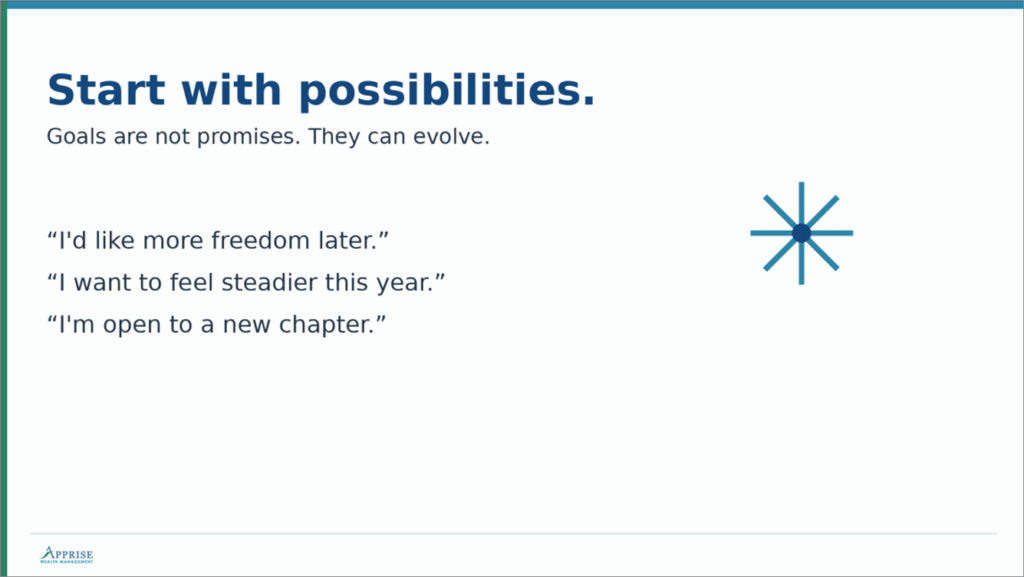

If you’re in a transition—Divorce, widowhood, empty nest, or even a career shift—goals can start to feel like pressure. So here’s a kinder way to approach them. Start with possibilities. Not because you’re lowering the bar, but because when life changes, you change.
Goals are often best guesses for today, and they can evolve. I explored this idea in a conversation on Apprise Wealth Management called “Goals Are Guesses with Carl Richards.”

Today I’ll use an EVOKE® lens: Vision, Obstacles, Execution. Then I’ll show you how guardrails protect your TEAM: Time, Energy, Attention, Money.
Vision does not have to be a final answer. It can sound like:
“I’d like more freedom later.”
“I want to feel steadier after everything I’ve been through.”
“I’m open to a new chapter, even if I don’t know exactly what it is yet.”
Consider what this can mean for you. You can set direction without locking yourself into a rigid outcome. Possibilities create movement. Pressure can create paralysis.

Next, we can discuss obstacles.
In my first meeting with clients after we create their vision, the conversation centers on, “What could possibly get in the way?” One obstacle can be decision fatigue. Too many decisions, too many moments to renegotiate the plan.
But obstacles are bigger than that. People often mention:
- Health or energy. “I don’t feel like myself right now.”
- Time. Here’s how I think about it. Time is often not the actual obstacle. We think of it as one, but it’s more often an excuse. What if we used our time more optimally and started limiting the things that don’t matter to us? Thinking of time as an obstacle can also signal that the plan has too many moving parts, so we need to simplify.
- Social pressure. Family expectations, comparisons, or a sense of having to keep up with others (FOMO).
- Lack of confidence. “I’m not savvy enough.”
- Cash flow constraints. “I can’t do that right now.”
This step matters because it turns vague anxiety into something workable.
Now, let’s consider execution and setting guardrails.
A guardrail is a pre-decision. It makes the next right step easier, especially when you’re tired, emotional, or rushed.
Here are three guardrails that can protect your TEAM.
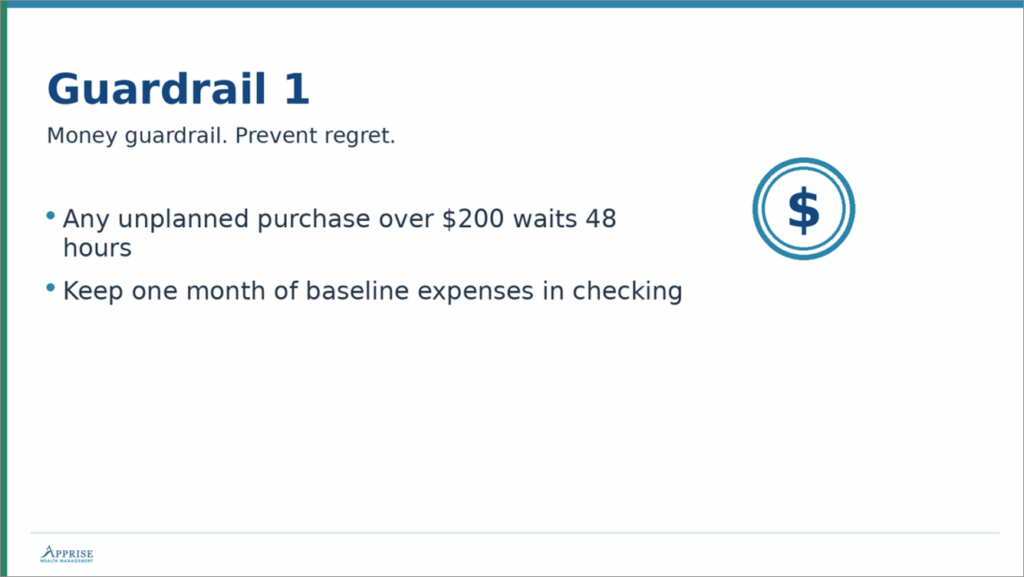
Guardrail 1. Money guardrail.
Choose one rule that prevents regret.
Try this: “Any unplanned purchase over $200 waits 48 hours.”
Or: “We keep one month of baseline expenses in checking.”
This thought process protects Money. It also protects Attention.
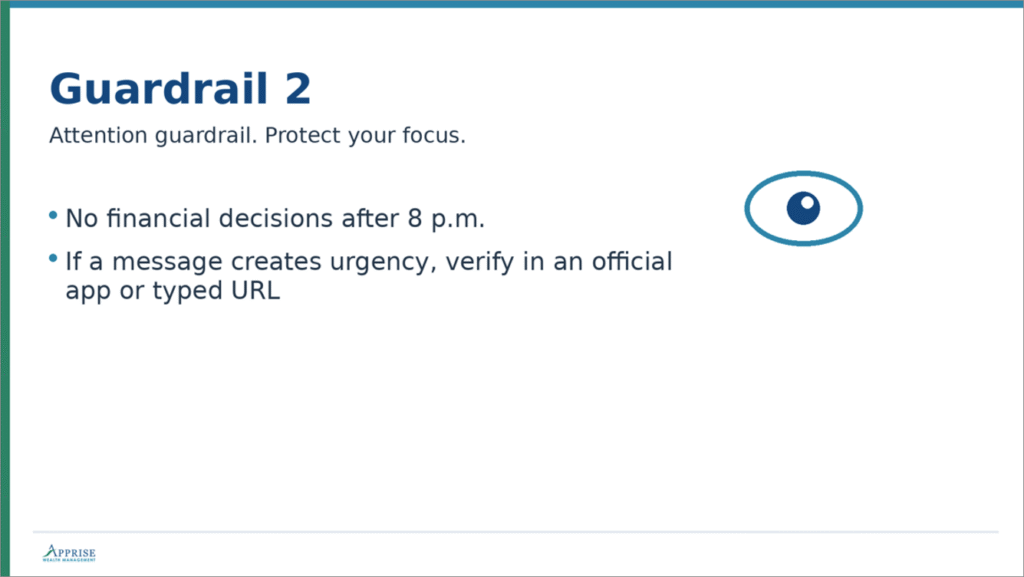
Guardrail 2. Attention guardrail.
Pick a time you do not make money decisions.
Try this: “No financial decisions after 8 p.m.”
Or: “If a message creates urgency, I verify through an official app or a website I type in myself.”
This approach protects Attention. It also protects Energy.

Guardrail 3. Time guardrail.
Make the plan lighter. Put one 10-minute weekly reset on your calendar. Same day, same time. Not a full budget session. Just a reset that keeps the plan alive.
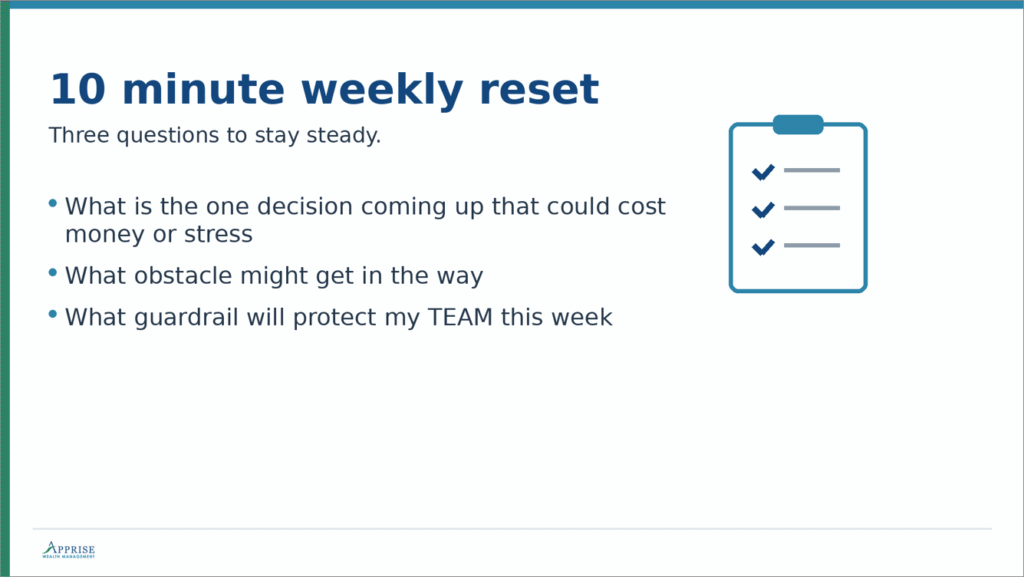
Once a week, answer three questions:
- What’s the one decision coming up that could cost me money or stress?
- What obstacle might get in the way?
- What guardrail will protect my TEAM this week?
One Caution: Guardrails are not a punishment. They provide support.
A common mistake: choosing too many guardrails at once. If you build ten rules, you’ll ignore them. Start with one guardrail that protects your TEAM.
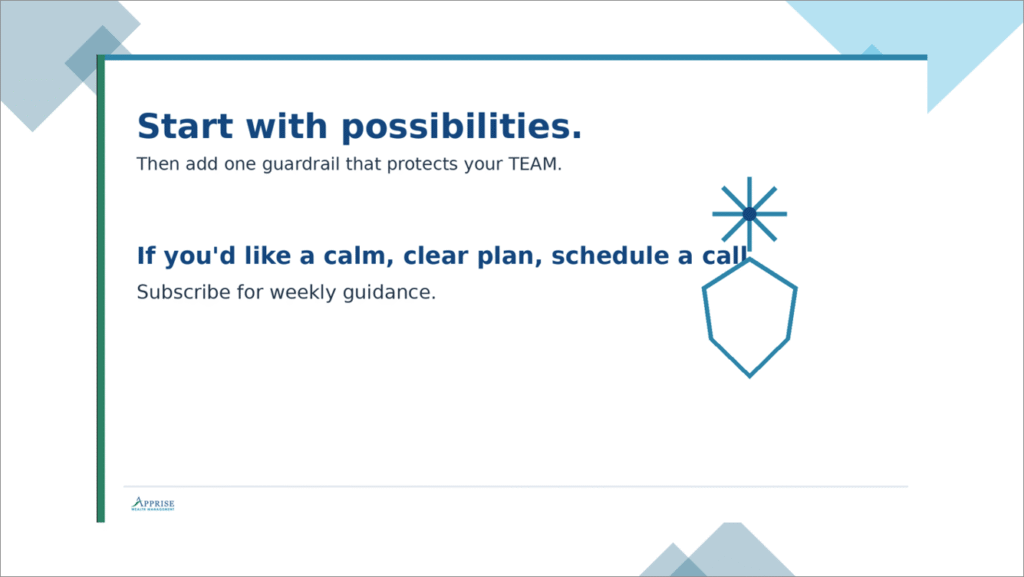
Here’s a quick recap. Start with possibilities, not pressure. Name the real obstacles. Then add a guardrail to make the next right step easier.
FAQs
1) What does it mean that goals are guesses?
It means goals are a best guess based on what you know today. You can adjust them as life changes, and you learn more.
2) What’s the difference between a goal and a guardrail?
A goal points you in a direction. A guardrail is a pre-decision that keeps you steady when emotions, stress, or busy weeks show up.
3) What obstacles usually get in the way of goals after a life change?
Common ones include health and energy, time pressure, social expectations, low confidence, and cash-flow constraints.
4) What’s one guardrail I can start with today?
Pick one rule that prevents regret, like a 48-hour pause for unplanned spending over a certain amount.
5) How does TEAM fit into this?
TEAM is a framework for protecting the resources that get stretched during transitions: Time, Energy, Attention, and Money.
If you’d like a calm, clear plan through your next chapter, schedule a call. If you want more practical guidance like this, subscribe.
Our practice continues to benefit from referrals from our clients and friends. Thank you for your trust and confidence.
Follow us:
Facebook | LinkedIn | Instagram | YouTube
Please note. We share new articles and practical planning ideas we think can help you make better money-related decisions on LinkedIn, Facebook, and Instagram.


For firm disclosures, see here: https://apprisewealth.com/disclosures/

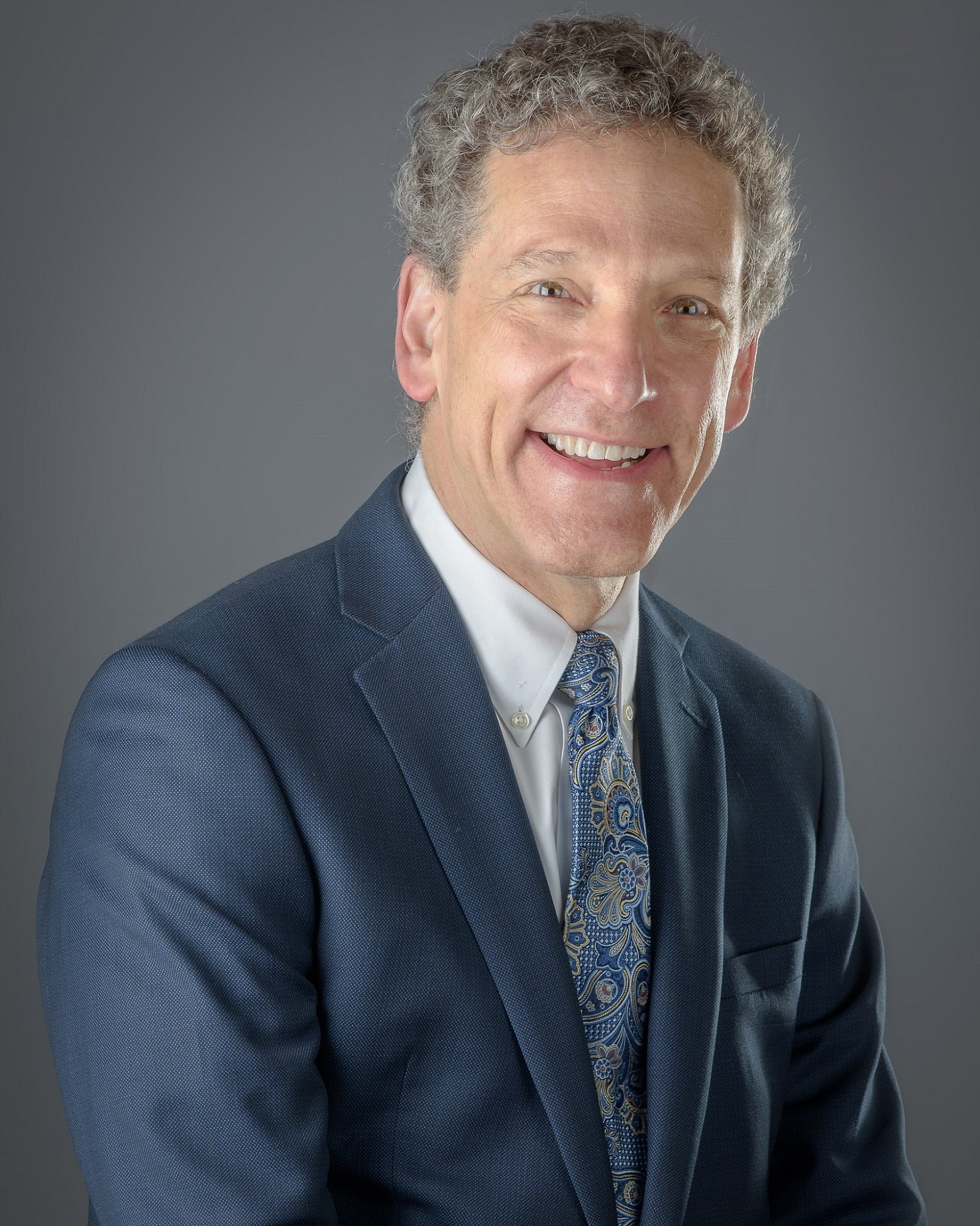
Phil Weiss founded Apprise Wealth Management, where he works with women facing new beginnings. He started his financial services career in 1987 working as a tax professional for Deloitte & Touche. For the past 25 years, he has worked extensively in the areas of personal finance and investment management. Phil is a CFA charterholder, a CPA, and an RLP®.